
The Horologist’s Loupe
The Horological Society of New York's newsletter (and today blog!) began publishing in 1936, and is one of the oldest continuously running horological publications in the world.
Reading Time at HSNY: Form Time to Time
This post is part of a series, Reading Time at HSNY, written by our librarians. Today’s post was written by Miranda Marraccini.
Picture this: you roll up to a meeting at work a few minutes early. Eyeing the empty seats around the perimeter of the conference table, you put your hand in your pocket and pull out…a tiny pair of deep red cherries. Is it some bizarre snacking ritual, your team wonders? A display of power over your dilatory direct reports? Suddenly, you pop open one of the cherries with a flourish, revealing a watch dial where the pit should be. You were checking the time! Everyone in the conference room is impressed and astonished.
Image 1
Thank you for indulging me in this scene. It’s imaginary, but the watch I described is very real, made in Geneva around 1830. Each cherry is about 20 mm across; the non-watch cherry contains perfume (image 1). These kinds of fantastical watches in unusual shapes are often called “form watches”; I contributed to an article in The New York Times about them in 2023.
At the end of the 18th century and the beginning of the 19th century, improvements in the technology of enameling and engraving on metal encouraged creativity in watch production. Artisans conjured realistic but tiny fruits, animals, hot air balloons, and different miniaturized musical instruments including lyres, mandolins, and even bagpipes. They are meant to be beautiful first, but they also show off the technical mastery of the Genevan artisans who created them–it is very difficult to create such tiny watch movements–ones as small as 10 mm across.
In “Watches of Fantasy,” a book in our library at the Horological Society of New York (HSNY), Fabienne Sturm has some ideas about why form watches were created, including to soften the inevitable blow of time passing. Time “endears himself to us when we measure his passing in the heel of a wooden shoe or under the wings of a pair of doves,” Sturm writes (I’ve included an image of the shoe she references in the header above.)
Image 2
I think this idea of watches reminding us of the bittersweet reality of time is especially true of watches that depict creatures that we think of as ephemeral, like butterflies or ladybugs. These watches demonstrate that time is passing on their dials, but also rebel against the effects of time by using materials that will last for centuries: imagine a fresh apple that never rots, a tulip always blooming. In image 2, an ornately enameled polychrome pear opens up to reveal not only a watch, but also a “perfume flask, portrait holder, mirror, and beauty-spot box.” You might notice perfume coming up a few times in this article–the way that scent evokes memory and desire seems to have a historical connection with horology. (That’s why we bottled our own HSNY fragrance!)
In Europe, form watches or fantasy watches reached the peak of their popularity at the beginning of the 19th century. This was before the wristwatch was invented. Both men and women were wearing their watches on chains, and as a result, the watches were often concealed in their pockets. According to Genevieve Cummins in “How the Watch Was Worn,” women first started to wear their watches on display on ornamental chatelaines, which also attached other useful objects like scissors and keys. Then they began to wear the watches alone as pendants around their necks.
Image 3
One from about 1830 is a watch in the form of a large key, which is also a pencil holder (image 3). Often, the watch dial is concealed beneath an enamel or metal cover. Some of the watches move: a flower bud that opens to reveal a dial inside, or a butterfly that spreads its wings. Some of them even contain musical automata.
Image 4
I particularly enjoy a little pistol from the early 1800s (image 4). It’s elaborately enameled and be-pearled, with a hidden compartment in the handle that conceals a tiny watch dial. If you pull the trigger, pop! Suddenly, a flower bud blooms from the end of the pistol, which in turn squirts perfume from its center. I think I personally like this one because of the way it takes an object associated with violence and makes it incredibly delicate and gem-like.
Image 5
Image 6
Image 7
I also like watches shaped like snails because they take advantage of the snail’s natural curved shell, and I think there’s a funny play on the idea of a snail moving slowly while time rushes ahead (image 5). Probably the most surprising animal I’ve seen represented as a watch is a sheep (image 6). Turn the sheep over and the reverse shows a lion (well, an approximation of a lion, if you squint). It’s a watch, it’s a parable, it’s a warning.
Some of the watches are “curio watches”—not meant to be worn or even really carried, they perform a second and even third function besides telling time. These include watches built into beauty-spot cases, vinaigrettes, glasses cases, snuff boxes, salt shakers, bouquet holders, and notebooks. From the 19th century onward, watches were built into cufflinks, cane handles (image 7), cigarette lighters, purses, compacts for makeup, card cases, and even mechanical pencils (as in one made by Tiffany & Co., in image 8).
Image 8
Image 9, from the book “A Dictionary of Wonders: Van Cleef & Arpels,” shows a 1934 example of an accessory called a minaudière. This little case, usually made of guillochéd metal and sometimes ornamented with jewels, could fulfill all the necessary public functions for a liberated woman of the 1920s: a detachable clip that could be reconfigured into a brooch, a makeup case, a mirror, a cigarette holder, a lighter, and of course, a watch. In image 9, the watch dial pops out from behind a rectangular hinged cover on the right side of the case.
Image 9
Image 10
In the 1960s, there was a fashion for pendant watches again. One that seems to come up a lot is a ladybug or beetle, often marketed to kids (You can see an example in the 1966 Oris ad reproduced in “How the Watch was Worn,” image 10). The wings open to reveal the watch underneath. My mom remembers wearing (and treasuring!) her ladybug watch in the 1960s. They’re still made today and vintage examples are being sold on places like Etsy. You can ogle some charming 20th-century examples of pendant watches and ring watches on the Little Old Watches Instagram account, run by Kaitlin Koch.
Image 11
As wristwatches became more popular in the 20th century, fewer people were wearing pendant watches and pocket watches. It’s not as feasible to wear a wristwatch in the form of a strawberry or a tiny shoe, so form watches or fantasy watches became rarer. But one could argue that the tradition of novelty watches is carried on in character watches, shaped like Garfield, Kermit, or C-3PO (image 11, from “Comic Character Wristwatches”).
Very recently, modern watchmakers have taken up the idea of watches shaped like animals, for example, a spider or a T. rex. One company heavily invested in these whimsical watches is Maximilian Büsser & Friends (known as MB&F). Image 12, from “MB&F the First Fifteen Years,” shows the “JwlryMachine,” a watch collaboration between MB&F and Boucheron in the shape of an owl. Under a translucent feathery breast carved out of rose quartz, the winding rotor swings, “to mimic the beating of the owl’s heart.”
Image 12
Some of these watches verge on automata, which could be a whole other article. And some automata run on watchwork, but no longer incorporate a dial that tells the time: a tortoise (another famously slow mover), and a snail with a hare’s head (moving both slowly and quickly).
What if your watch, instead of a simple circle or cushion case, could be a tiny pizza slice or miniature rocket ship? What would you want your fantasy form watch to look like? The watches in this article are proof that form doesn’t need to follow function; form is an independent entity, a wild creature without limits, following nothing.
Reading Time at HSNY: Serving Up Seconds
This post is part of a series, Reading Time at HSNY, written by our librarians. Today’s post was written by Miranda Marraccini.
I ended my last article with photographs of some truly spectacular bread roosters from a book in our library collection at the Horological Society of New York (HSNY). (What does a rooster-shaped loaf have to do with horology? You’ll have to read it to find out!) Well, after that savory hors d'oeuvre, it turns out the horological masses were positively CLAMORING for more epicurean content. And I’m always happy to focus on food, in my writing as in my life. I’ve whipped up some mouth-watering tidbits for you today: watches that look good enough to eat (but you must resist!), chefs who flash wrist-candy in the kitchen, clock-themed eateries, and in-jokes involving edible hairsprings.
Image 1
Image 2
Let’s start with breakfast: a cup of tea, perchance? The eccentric horological contraption in image 1 is called a teasmade, a delicious portmanteau if I ever heard one. It’s the cover illustration for the straightforwardly titled “Eccentric Contraptions,” a book in our library. According to the author, the Victorians invented this device to make a brew without emerging from your warm duvet: “when the alarm clock triggered the switch, a match was struck, lighting a spirit stove under the kettle. When the water came to the boil, the steam pressure lifted a hinged flap, allowing the kettle to tilt and fill the teapot; then a plate swung over the stove and extinguished the flames.” Seems foolproof to me! This particular teasmade comes from Birmingham, the center of the watch and jewelry trade in England at the turn of the 20th century.
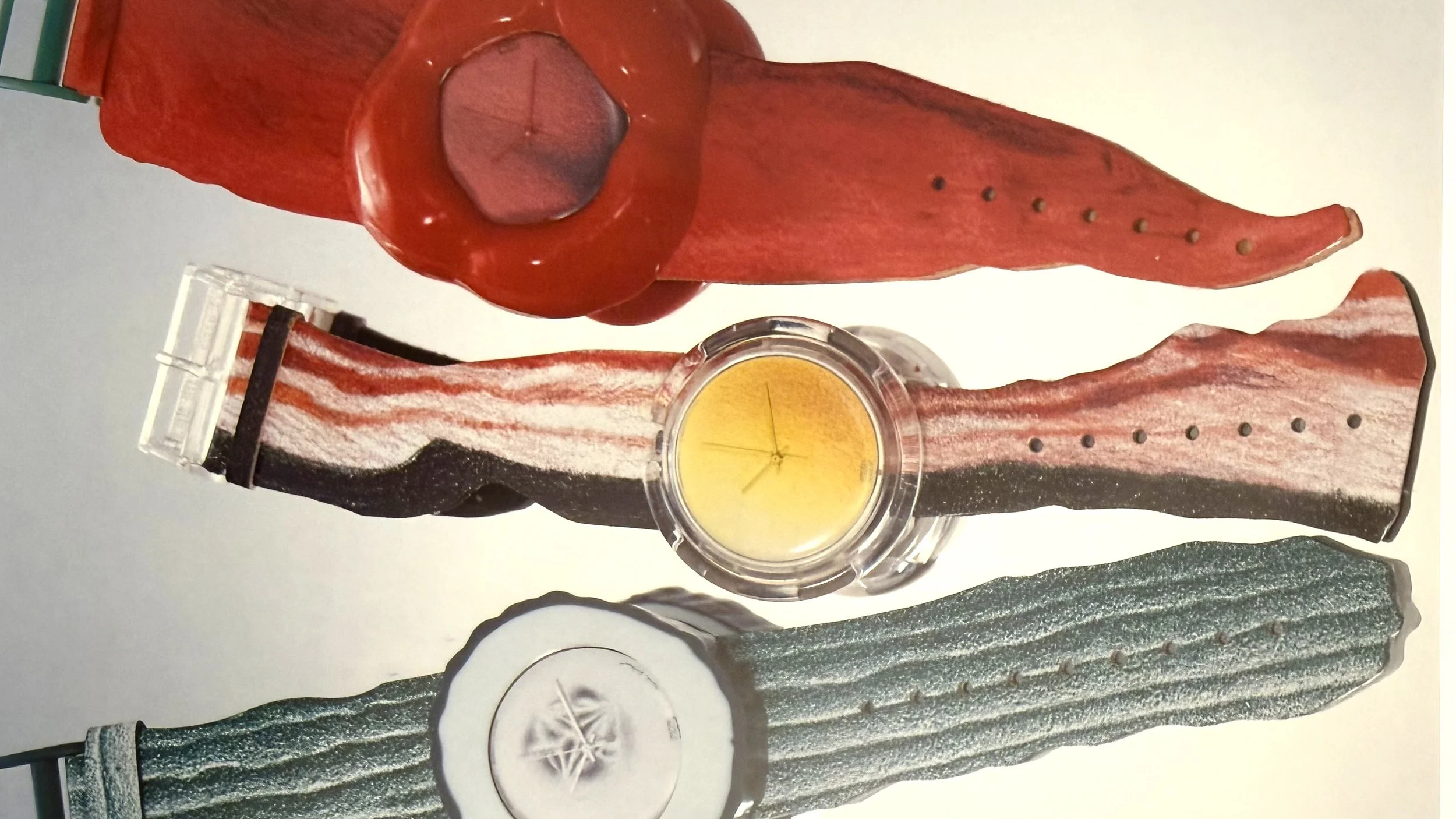
Now that we’ve had tea, would you fancy some eggs and bacon, with a side of fresh-cut, glistening veggies? The wacky non-edible Swatch watches in image 2, designed by Alfred Hofkunst, premiered in 1991 as a limited edition. As a promotion, Swatch sold them in actual vegetable markets. There’s a cucumber, a fried egg over a strip of bacon, and a red pepper model, all rendered in delectably detailed plastic and rubber. A page from the book “Swatchissimo, 1981-1991,” which celebrates the first 10 years of Swatch production, shows these watches in all their puffy glory. My favorite feature is the names of the models, which are multilingual puns: “gurke” means “cucumber,” so “Gu(h)rke” incorporates an h in the word to form a pun on the German “uhr,” meaning clock or watch. The breakfast one is called “Bonju(h)r,” a similar French/German pun, while the pepper watch “Verdu(h)ra,” plays on the Italian and Spanish word for “vegetable.”
As you might imagine, these food Swatches are collectible, with a set on eBay available for $630 at the time of writing. Have you always wanted to embody the crispness of a crudité tray? Or would you feel perturbed by a brunch guest missing their fork and biting your wrist instead? That’s certainly a risk you’ll have to take if you want to wear one of these.
If watches can be food, then watches can appeal to those in the food industry. Celebrity chefs are a known watch-collecting community, with chef-watch couplings reading like wine pairings on a menu: Kristen Kish and her Cellini, Dominique Crenn and her Royal Oak, Gordon Ramsay and his white gold Submariner “Smurf” (or one of his many others). Hodinkee recently ran an article by multi-hyphenate chef and writer Eddie Huang in which Huang nominally discusses wearing a watch in the kitchen, while musing about Pop Smoke, getting T-boned in a car full of loose marijuana, and the excruciating mundanity of the hamburger.
In “A Man & His Watch,” a popular book in our library, a couple of chefs are featured, including Eric Ripert, the chef and co-owner of Le Bernardin in New York. In the book, a collection of first-person testimonials, Ripert compares the craftsmanship of cooking to that of watchmaking, writing: “Take making a sauce: you can’t measure an ounce of flavor–it doesn’t exist that way. It’s intangible; you can’t dissect it…So it’s the same with watches: it’s craftsmanship until you reach a certain level of complexity. Then it’s artistry.” Ripert also admits to “banging up” expensive watches in the kitchen: “I have the watch to use the watch!” He wears a Vacheron Constantin Historiques American 1921.
Image 3
Most modern watches are sturdy enough to withstand the steamy, high-contact world of a restaurant kitchen, but this robustness is a relatively recent development. In image 3, an ad that appeared in American Horologist and Jeweler in 1965 touts the development of Incabloc technology. Incabloc is a patented shock protection system invented in 1934; it uses a special spring mounted over a jewel to shield the delicate balance staff from impact when a watch is dropped. According to this Europa Star article, which covers this handy invention in more detail, more than 80% of all watches utilized Incabloc by the 1960s.
In image 3, an ad for Incabloc demonstrates its shock protection feature by comparing a watch to a fragile egg. On the right is a broken shell; on the left is an intact egg, with a cutout showing an undamaged watch movement, with its Incabloc system visibly in place. It stands out because the red ruby is the only part of the ad in color, except for the lyre-shaped spring that is the company logo at the bottom.
We’ve covered celebrity chefs and their watches, but haute cuisine doesn’t have a monopoly on horology. A decidedly less upscale establishment that features in our collection is the Tick Tock Tea Room, pictured in an undated postcard in image 4. This picture stands out immediately among our horological postcards, which mostly feature public clocks, museums, vintage watch advertisements, or historic factories. This card, in contrast, shows a cozy, if dated, red and pink dining room furnished with crimson diner chairs so pleathery-looking you can almost hear them squeak, and decorated with an entire estate sale’s worth of clocks.
Image 4
The Tick Tock was a Hollywood, CA standby that opened in 1930 and lasted until 1988. It served cheap, filling comfort food to lonely transplants, according to this local history, making a name for itself with 65-cent turkey dinners and orange sticky rolls. Art and Helen Johnson, who moved west from Minnesota, decorated the cafe’s first location with a single cuckoo clock, and the theme kind of exploded from there. I can spot at least nine clocks in the grainy photograph above; available photos online show even more.
I think the clocks make the space feel cozy, though I do wonder if the ticking was intolerable. Maybe the Johnsons didn’t keep all the clocks running. From the nostalgic descriptions I read, it seems like the decor helped Angelenos feel like they had a kind of home, where someone was there day or night to welcome them to a dinner table groaning with mountains of potatoes. Perhaps I’m romanticising, but this is the LA I imagine from movies, the way LA imagines itself.
Image 5
For the New Yorkers out there, there’s nothing more local than a bagel. I like an everything bagel with scallion cream cheese myself, but perhaps you prefer nova, capers, or even a BEC? (If it’s a cinnamon raisin bagel that thrills you, we might not be friends.)
We found the drawing in Image 5 in our administrative archives at HSNY. Titled “How to prepare & consume a New York gourmet’s delight,” it depicts a bagel with lox and schmear, separated into its component layers, schematic-style. They are neatly numbered and captioned from top to bottom, with each striation representing a horological in-joke. The top half of the bagel (1A) represents HSNY, while the lox represents the Bulova and Seiko watch companies. At the bottom of the image, an arrow points from the “assembled melange” into the gaping mouth of a bespectacled eater, presumably the gourmet of the title.
We think this was the creation of an HSNY member in the 1970s. There are layers to this sandwich that I will never understand. Why, for instance, are all the parts of the sandwich representative of HSNY except for the lox? Does the inclusion of the Bermuda onion indicate a reference to a specific member (maybe someone who retired to Bermuda?) And most pressing, what kind of bagel is HSNY???
Although the bagel in image 5 is merely symbolic, HSNY hosted “a series of entertainments, picnics and dances” featuring actual food starting with our beginnings as the Deutscher Uhrmacher Verein (German Watchmakers’ Society). The earliest of these events were humble “smokers,” but they evolved into elaborate banquets and eventually into the black-tie galas we host today at venues like the Plaza Hotel. (A few tickets still available for 2026!) In image 6, a selection of banquet programs gives a sense of the scope of celebration over the years.
Image 6
Image 7
In this 2023 article I wrote about HSNY galas and banquets, you can get a real mouthful of what HSNY members and their guests were eating over the years. If I were eating at an elegant HSNY gala in the 20th century, I’d go for the amontillado sherry, the “grapefruit supreme,” or the “tutti frutti ice cream logue,” but skip the “sweetbreads en casserolettes.” To each their own, however!
An early German-language banquet menu in our archives, from 1912, includes some standards like oysters and Brussels sprouts, but also some curious items like “enamel filet with cuvette sauce,” “horological cream puffs,” “spindle clock cheese,” and under salads, “etched hairsprings with double-proofed acidic chronometer oil.” All of the delicious dishes involve puns on watch and clock parts.
If all of this inspires you to get into the kitchen yourself, why not take inspiration from one of our new library acquisitions, “The Gilded Age Christmas Cookbook.” We acquired the volume for our library because of HSNY’s own 19th-century past, recently featured in HBO’s “The Gilded Age,” seasons two and three. Written by Becky Libourel Diamond, the book includes adaptations of real Gilded Age recipes for the festive season (including Hanukkah and New Year's) interspersed with short essays about celebratory practices of the period. Image 7 shows a recipe for “mock mince pie,” a dessert to round out our meal today.
I just ate my weight in potatoes, so I’m too full to be tempted by all the horological treats I’ve written about here. However, I do hope this will inspire you as we head into the holiday season, when every time of day is an acceptable snacking time, and when each hour marker on the dial, if you look closely, just reads “yum.”
Reading Time at HSNY: You Don’t Need a Weatherman
This post is part of a series, Reading Time at HSNY, written by our librarians. Today’s post was written by Miranda Marraccini.
If you’re familiar with our library at the Horological Society of New York (HSNY), you might not be surprised to learn we have books in our collection about lathes, sundials, and mechanical singing birds. Maybe you’ve seen other articles where I even mention some of our more offbeat offerings, say, a volume about jukeboxes or a study of the Loch Ness Monster. But what about eyeglasses, thermometers, barometers, and weather vanes? All topics you can read about at our library!
Our collection is especially strong in the field of scientific instruments. Prominent watchmakers often manufactured other optical tools or measuring devices, and even if not produced together, these classes of implements were often sold by the same retailers. Basically, if you can craft minute metal pieces with the extreme delicacy needed to function inside a precise watch, you can make a fine telescope, say, or a really fancy thermometer.
Sometimes scientific functions can even be combined with time-telling in complicated watches. In fact, one of the most famous complicated watches of all time, the Leroy 01, contains a thermometer, a barometer, an altimeter, and a hygrometer among its 25 functions. This 2014 article from the National Association of Watch and Clock Collectors explains the story of the watch and includes a list of its complications, including Northern and Southern Hemisphere sky maps, local time in 125 cities, and time of sunrise and sunset in Lisbon.
Image 1
Image 2
Above, images from one book in our library, “La Leroy 01, Ultra Compliquée,” in French, show a secondary dial on the famed watch with nine indications (of the 25), including hygrometer, barometer, and thermometer. Image 1 shows the dial, and image 2 explains how the hygrometer works inside the movement.
The hygrometer measures humidity using an actual human hair–as anyone knows who has tried to attend a formal wedding in August, hair’s length changes with humidity. The alteration in length can be quantified and paired with an indicator ranging from zero to 100. At least according to my crude translation, this book also claims that blonde hair works better for measuring humidity, proving that blondes not only have more fun, they are also better meteorologists.
Because of the overlap between horology and scientific instrument manufacture, our collection contains a number of books about scientific instruments, particularly those that measure the weather, including “A Treatise on Meteorological Instruments” (a reprint of an 1864 volume); “English Barometers 1680-1860”; and the intriguingly named “Barometers: Wheel or Banjo.” (Why not both? You’ll have to visit our library to find out.)
In our archival collection, we hold the papers of the Henry J. Green Company, manufacturer of meteorological and scientific instruments. James Green and his nephew Henry J. Green were important barometer makers and sold to institutions like the U. S. Navy and the U. S. Weather Bureau. A generous relative donated the company’s papers to HSNY a couple of years ago.
James Green, an English immigrant, started manufacturing “philosophical instruments” in Baltimore in 1832 and moved to New York a few years later (and to Brooklyn in 1890). Green’s bread and butter was the mercurial barometer, in which the level of mercury in a glass tube indicates how strongly the atmospheric pressure is pushing down outside the tube. Higher air pressure generally means clearer weather, while low pressure means clouds and rain, and extremely low pressure, the kind that makes your ears pop, means you’re inside a hurricane. After manufacturing quite a lot of barometers, Green quickly expanded into thermometers, used for meteorology and in laboratories.
Image 3
Image 4
In 1877, the United States Signal Officer, part of the U. S. War Department, wrote to Green asking for a volume discount, and Green obliged (image 3). Prices ranged from $3.00 for a pocket thermometer ($2.50 with the discount) to $100 for an observatory barometer. Green and the Signal Officer, actually a series of officers and administrators, carried on a robust trade throughout the 1870s and 1880s.
In 1883, the Chief Signal Officer requested some custom glass bulbs and glass tubing for a type of thermometer called a Jolly air thermometer (it’s not particularly cheerful; just named after someone called Jolly). He included a sketch of what he wanted, with dimensions (Image 4). A later letter from Green shows a particularly elaborate Gilded Age letterhead, bearing an image of a medal that Green received at the International Fisheries Exhibition, a kind of World’s Fair in London in 1883 (Image 5).
Image 5
Image 6
Many of the letters in the collection are all obliging, full of praise for Green’s instruments. However, like any business, there were unhappy customers. In image 6, the Chief Geographer from the U.S. Geological Survey writes to Green: “I regret to say that the cisterns of two of the barometers sent me some time ago, are leaking so badly that the instruments are temporarily worthless…the loss of the observations will cripple our work.” He requests a new barometer “at once” and ends his letter “Hereafter I must beg you that you put your instruments in such order that difficulties of this kind will not arise as they cause very serious trouble.” I don’t know how this particular situation resolved.
In addition to the Navy and Weather Bureau, Green corresponded with the Surgeon General, U. S. Patent Office, U. S. Geological Survey, and university observatories across America and Europe.
By the 1950s, H. J. Green was manufacturing barographs, rain and snow gauges, anemometers, wind vanes, thermographs, hygrometers, evaporimeters, and psychrometers (no, none of those are made up). Did you know there was so much to quantify about weather? A midcentury catalog (image 7) shows two types of barometers, a mercurial barometer (contains mercury, obviously) and an aneroid barometer (one that doesn’t use any liquid inside). Another page shows wind velocity and direction indicators, including ornamental wind vanes at right (image 8). We might not think of weather vanes as scientific instruments, but they do report data about atmospheric conditions, namely, which way the wind is blowing.
Image 7
Image 8
Image 9
Another curiosity is a book whose title translates to “Church Steeple Weathercocks and Weather Vanes in Everyday Life and in Art History” (it probably reads better in the original German.) Josef H. Schröer, the book’s author, founded a museum of weather vanes from his own collection. His wife, Ina, writes in her foreword to the book that the “specimens” joined the family gradually over 40 years, and that over the course of that time “they…also crept into my heart!” I can see this must be true because the book also includes a poem on the same topic by Ina.
Ina Schröer goes on to discuss the Christian symbolism of roosters and why they appear on top of churches. Although the book is exhaustive, there isn’t a huge amount of variation among the vanes. There are a lot of roosters and crosses, with a smattering of other religious figures, like the archangel Michael battling Satan (image 9). I was surprised to discover, however, that the author included his own accomplished creations in another area: baking bread in the shape of weather vanes (image 10).
We’re verging on another subject here, the connection between horology and food, which I think deserves its own article. Let me know in the comments if you agree, because these scrumptious-looking bread chickens are making me peckish.
Image 10
Reading Time at HSNY: Ex Libris

This post is part of a series, Reading Time at HSNY, written by our librarians. Today’s post was written by Miranda Marraccini.
Have you ever looked at a book in your collection and thought, “I need to make absolutely sure potential thieves know this book is mine”? Or maybe just, “This book could use a little pizzazz”? If the answer to both of these questions is no, well, then we don’t have much in common. But if you’ve ever considered how to inscribe your books in a manner befitting your sparkling personality, then you might have something in common with both the author of this article and the former owners of books in our library at the Horological Society of New York (HSNY).
Although HSNY’s current collection is largely the gift of one generous bibliophile, Fortunat Mueller-Maerki, he bought most of his books secondhand. Many contain marks of their previous owners. I’ve often appreciated how these names and inscriptions add meaning to the books they adorn, telling stories about how people have used and loved them over the years. Most of the book traces I’ve written about previously have been handwritten, but in this article, I’ll focus on bookplates, which are printed expressions of ownership pasted to the inside of a book. Because our Jost Bürgi Research Library collection specializes in the study of time and timekeepers, former book owners sometimes bought or commissioned bookplates that incorporated horological themes.
Image 1
Of the bookplates I’ve snapped photos of, the one in image 1 particularly caught my eye, and you can probably guess why. It includes a six-pointed star, a naked woman tastefully framed from the back, and a number of symbols of the book owner’s interests including, clockwise from top right: a watchmaker’s lathe; violin and sheet music; executioner’s tools; escape wheel; quill pen; magic tricks; Egyptian symbols; a classical column; some things I can’t identify that look like fireplace tools; and a black cat with witch’s broomstick. The middle of the bookplate features the mysterious sator square, a Latin palindrome that has served as a mystical and religious symbol for hundreds of years. At the top and bottom of the central star, the Greek letters alpha and omega denote the Christian God.
Who, you might ask, was the owner of this book, apparently a person of myriad interests? Henry V. A. Parsell, Jr. was a multitalented Reverend (later Bishop), “electrical genius,” and engineer from a wealthy new-money New York family. He wrote a book called “Gas Engine Construction" and “made an exhaustive study of evolution, astronomy, archaeology, and many different philosophies,” according to a newspaper article about him. “Many different philosophies” included a now-defunct Masonic order called the “Egyptian Rite of Memphis,” which may explain the ancient Egyptian symbols in the image.
Parsell commissioned Jay Chambers, a well-known graphic artist and illustrator of the time, to design this bookplate–he was one of the three partners at the Triptych Designers of New York, named in the signature at bottom right. This bookplate is remarkably detailed and personal, even compared to others in our collection. I feel I know a little bit about the adventurous Mr. Parsell and I would like to know more, because he seems like an eclectic character, to put it mildly. More than that, though, I think this bookplate encapsulates the joy of our library collection as a whole: eccentric, multifaceted, varied, and strange.
Image 2
As you might expect, quite a lot of bookplates in our library contain imagery that reflects either the container (a book) or the subject (time). I’ve written about one before, a bookplate belonging to the late historian Silvio Bedini (image 2). It shows a person absorbed in study behind a chaotic rubble of books, with the motto “Satis Temporis Non Est Nobis” or “For us, there is not enough time.” Visitors to the library often ask me if I’ve read all the books in the library (ha!) or, if not, to estimate what percentage of the collection I’ve read. Readers, there is never enough time.
Gerald S. Ruscoe has gone a bit more obvious with his bookplate, in which an hourglass sits on a pile of books covered with vines (image 3). The text on the top reads “Books Span the Ages…” and also shows a lamp of knowledge producing smoke. Putting on my “professional bookplate critic” hat, I will say the design is a little tame. This book is comfortable resting on the shelf behind the couch. This book might be afraid of taking the subway.
The same idea shows up in the bookplate of one F. L. Thirkell, although his imagery is more hardcore: Father Time shouldering a scythe, standing on the pages of a giant book that seems to be floating in the clouds like a sort of magic carpet of death (image 4). The bookplate says to me: your ride is here to take you away, and you won’t be coming back.
Image 3
Image 4
Thirkell was a Fellow of the British Horological Institute (BHI) who published in the BHI’s Horological Journal, including illustrated articles on how to repair specific models of watches. In my research, I didn’t find much about him as a person, but judging entirely from his bookplate, I would guess he enjoyed Black Sabbath (RIP Ozzy), gossiping with his pet rabbits, and scaring children with his Halloween decorations.
For the winner of the “most horological” award, I’d nominate the bookplate of Hugh L. Marsh, onetime treasurer of the National Association of Watch & Clock Collectors (NAWCC) (image 5). Marsh’s bookplate reproduces a hilariously over-the-top illustration from a late-17th-century book of fancy costumes.
Image 5
In the book, “Recueil les Costumes Grotesques et les Métiers,” each artisan wears the literal tools of their trade as clothes. For example, an apothecary walks around covered in bottles and funnels; a glass merchant dons mirrors and chandeliers. In this case, a watch-and-clockmaker wears, well, a ton of clocks. You can see the details better in the original image: he’s got chiming bells on his head, a coat festooned with dials and tools, and sleeves clank-clanking with watch cases at the elbows. It’s chaos. And, as two of my colleagues independently noted, it would make a great Halloween costume.
One of my favorites among the bookplates I discovered has absolutely nothing to do with time, books, or mortality. It’s a lovely Siamese cat, looking delightfully bemused to find itself inside “The Artistry of the English Watch.” As a cardigan-wearing librarian, I am, of course, a cat lover myself–I once acquired, in a white elephant gift exchange, a sign for my desk that reads “Ask me about my cats.”
Image 6
This cat bookplate belongs to Shelagh Berryman, one of the few female book owners represented in our collection (though many more are anonymous). A 1986 edition of The Music Box, an International Journal of Mechanical Music, reports that Berryman’s shop in the town of Wells contained the “second smallest museum in England”: “A large room above the shop…houses a collection of musical boxes of which browsers in the shop below who become entranced by the wonderful collection of goods on display for sale, may for a 50p fee, browse upstairs too. A demonstrator is present and these instruments are also for sale.” By 1988 Shelagh and her husband Douglas had expanded to a second shop in the bigger city of Bath, so they seem to have achieved a certain level of success.
Berryman owned at least two books in our collection, the other being “The Camerer Cuss Book of Antique Watches”. I like to think her bookplate expresses the multifaceted nature of many horologists, and in fact, most humans: sure, we’re watch people, but we can be cat people too. We have a sense of humor and whimsy about ourselves.
I’ll close with one last genre of bookplates I’ve noticed: messages to book borrowers. For example, the bookplate of George O. Keenan (image 7) contains a gentle warning: “I enjoy sharing my books as I do my friends, asking only that you treat them well and see them safely home.” Keenan, whom I couldn’t find much about online, clearly enjoyed lending volumes from his personal library to friends, as evidenced by the slip in this book. Evidently, he had no need to resort to a book curse to discourage thievery.
Image 7
Image 8
I’m not sure if anyone ever borrowed “United States Clock and Watch Patents,” but if you’d like to look at this very helpful reference work, you’re welcome to do so at our library anytime! And if you’re a member, you can even borrow it; just make sure to treat it well and see it safely home. Or if you prefer the more vulgar version, written in one of our other books owned by Cullen Tucker of Flemingsburg, Kentucky (image 8): “If this book should chance to stray kick it in the ear and send it home.”
For my part, I think my own fantasy bookplate design would feature some combination of my primary interests: tortoiseshell cats, fountain pens, watches, and of course, garlic (that last one might be a challenge to incorporate). What would your bookplate look like? Perhaps you already have one! If so, I salute you. I hope to see your bookplate proudly carrying your name into the far-off future, whether in our cozy library or as part of some distant collection, possibly in space, circling an unfamiliar star.
Reading Time at HSNY: Horology FAQ

This post is part of a series, Reading Time at HSNY, written by our librarians. Today’s post is by Miranda Marraccini.
In the course of my three-plus years welcoming visitors to our library at the Horological Society of New York (HSNY), I’ve developed a kind of intuition for the types of questions I tend to get asked, horological and otherwise. I don’t want to brag, but most people will get only a few words into their query before I have some idea of what they’re looking for and how to find it. After all, it’s my job, and I enjoy it immensely!
Not everyone can visit the library in person to politely pepper me with their inquiries, however. So this month, I’ve devoted my article to answering some of the most frequently asked questions I receive on a daily basis at the library.
Of course, you’re in front of a screen right now, so it’s possible you’ve already asked ChatGPT these questions. But if you don’t feel satisfied with the answers our robot overlord offers, why not take some advice from me, your friendly time librarian? I can guarantee you I’m not hallucinating. Here are 12 FAQs, one for every hour on the dial, in no particular order.
What is the number one book for a beginner in watchmaking?
It doesn’t get better than George Daniels’ “Watchmaking.” Daniels, probably the most renowned horologist of the 20th century, created a novel co-axial escapement that dramatically reduced the amount of friction produced as a watch runs, which, as my readers know, was a BIG DEAL. So he knew what he was talking about, to say the least.
In all, we have no fewer than 21 books authored, part-authored, or edited by Daniels. We have several copies of “Watchmaking” available at all times at HSNY, as well as “The Practical Watch Escapement.” Daniels co-authored the straightforwardly titled “Watches” with Cecil Clutton, which is an excellent illustrated historical overview of watch development.
Image 1: Dial decoration patterns from “The Magic of Watches” by Louis Nardin.
Daniels can be a dense read, though. If what you’re interested in is building your own watch, one option is “Beginner Watchmaking: How to Build Your Very First Watch” by Tim Swike. What I like about this very conversational book is that the author assumes zero knowledge and includes many large pictures. He introduces the reader to each part of a watch and includes quartz watches, which many authors don’t. Swike shows you how to find an affordable watch online and then customize it with a new dial, hands, band, or movement.
Another option for learning repair is the classic “The Watch Repairer’s Manual,” written by HSNY President Henry Fried in 1949 and still as relevant as ever.
If what you’re interested in is learning about watch collecting and the luxury watch industry, I recommend “The Magic of Watches” by Louis Nardin. Image 1 shows an illustrated page of dial decoration patterns you might find in high-end watches.
How much is my Rolex worth?
If you show me your wrist, I’ll make you an offer!
Just kidding. We don’t offer valuations. But your friendly librarians at HSNY are happy to help you research any brand or type of watch. For Rolex, some of our newer offerings are “Vintage Rolex: The Largest Collection in the World” and Mara Cappelletti’s “Rolex Philosophy.” For Patek, you might like to peruse John Reardon’s learned oeuvre.
But what’s the best watch? Should I buy a Rolex or Omega or Patek?
The best watch is the one you love, the one you’ll wear even when you’re not going anywhere but the bagel place, or even just sitting on the couch. I’ve got tiny vintage watches that spark joy every time I wear them, all bought for under $150. There really is no universal watch.
If you’re looking for a watch as an investment, one place to search is our collection of vintage price guides. You can find a watch that was collectible in 1989, and see how much it’s going for today. It’s probably faring better than your Beanie Baby collection.
I inherited a pocket watch from my grandparent. How do I find out more about it?
The internet can be really helpful for this kind of question, because enthusiasts make it their business to track down obscure makers and untangle convoluted industrial histories. I often refer visitors to the NAWCC members’ forum, where helpful horologists ask and answer questions about dial painting, electric horology, and even recovering stolen watches. The American Pocket Watch forum is especially active. I also recently discovered the Pocket Watch Database, which is very user-friendly for the non-initiated (like me).
If you’d like to bring your pocket watch (or pictures of it) into our library, we’ll do everything we can to help you learn more about the watch’s manufacture and its history. Our pocket watch section is robust, covering European and American models in detail. Reinhard Meis’ “Pocket watches : from the pendant watch to the Tourbillon” is pretty comprehensive.
How can I become a watchmaker?
“I like to take watches apart but I can’t put them back together.” That’s the line I hear most often from visitors at HSNY who are interested in learning more about watchmaking. There’s no need to struggle on your own, squinting at a diagram or advancing laboriously through a YouTube video frame by frame. (No shade to YouTube, still an excellent learning tool.)
You can get some hands-on experience in one of our classes, designed just for beginners. If you drop a screw, well, you won’t be the first or the last. A few classes won’t qualify you to be a watchmaker, however. Just like any career, if you decide you want to pursue watchmaking full-time, you can pursue a full-time certification program. There are nine US-based options for you, and we offer scholarships to all of them.
A classic horology textbook that we have in our library is “Theory of Horology,” always in high demand for watchmaking students and aspiring students. Also popular is the Joseph Bulova School of Watchmaking Training Manual.
I wear a smartwatch. Am I welcome here?
No, we’ll chase you off the premises. Yes, of course! In fact, my co-librarian, St John Karp, recently wrote an article about this very topic. Smartwatches have their place, and we even consider them a kind of gateway watch that encourages the wearer to try on other types of wristwear. You don’t need to wear a mechanical watch, an expensive watch, or any kind of watch at all to participate in our programming.
How can I get my watch repaired?
One option is to learn the basics yourself in one of our evening or weekend classes, described above, and repair it yourself! The books I recommended in the first answer will help you follow up and expand your knowledge.
As a nonprofit, we do not endorse specific businesses. A good resource is the American Watchmakers-Clockmakers Institute’s “Find a Professional” website, where you can do your own research. You can enter your ZIP code and get a list of watch and clockmakers in your area, sorted by specialty.
What do you do here?
As a librarian, I help answer people’s questions about watches, clocks, calendars, navigation, sundials, and many other topics related to time and timekeeping. Alongside my co-librarian, St John, I choose new books to add to the collection; organize our ephemera, books, and catalogs; and write about the library, along with other outreach.
You’re welcome to come to the library to conduct your research, or email us with questions at library@hs-ny.org. And if you just want to browse and admire the view of 44th Street from our spectacular windows, feel free to stop by for that reason too!
I spoke in detail about the job of a horological librarian on a 2023 episode of “The Waiting List,” a watch collecting podcast. Some of the information about HSNY is now outdated, but if you’re the type of person who wants to get into the weeds about Library of Congress classification, you’ll enjoy this chat.
What is longitude and how is it related to time?
It’s a long story (har har.) Dava Sobel’s “Longitude” is still one of the most important works on this topic, and we have several editions of the book, including an illustrated version and translations in German, French, and Italian.
Basically, the very short version is that before the late 18th century, European mariners had limited options for figuring out longitude, their east-west position as they crossed oceans. Lots of them died of scurvy in the middle of the vast watery expanse. The British government (among others) offered a prize for determining longitude, which eventually led to the development of the marine chronometer. This device could tell time at sea precisely enough to calculate distance traveled, which in turn allowed the determination of a ship’s longitude.
For more, check out this article I wrote a couple of years ago that illustrates the race to develop the marine chronometer with contemporaneous books.
What is time?
Image 2: “The Book of Time” by Gerald Lynton Kaufman.
My colleague St John asks this question every time a physicist stops into the library and reports getting this answer back: “We’re working on it.” But if you’re interested in exploring this big question, we do have several sections of the library where you’ll find relevant information, including our philosophy shelves. That’s where we keep books with titles like “Travels in Four Dimensions”; “Time, The Familiar Stranger”; “A Watched Pot: How We Experience Time”; and of course, “What is Time?” (two different books). Image 2 shows a particularly attractive book jacket design for “The Book of Time,” which covers no less than eight dimensions, “proving that Time does not exist, and also that Time always exists.”
Why does a clock have 12 hours (or 24)?
I’m also going to leave this explanation to St John. He reports that in her essay in the 2001 book “The Discovery of Time,” Harvard scientific instrument curator Sara Schechner unearths an answer. In St John’s words, “the Egyptians recognized 36 time-telling stars, of which only about 12 were visible on a given day, so the night was divided into 12 parts based on the rising of these stars. This led them to divide the day into 12 parts as well… The 24-hour day then reached the Babylonians, then the Greeks.”
As far as “the subdivision into 60 minutes and seconds,” according to St John’s research, that comes from Mesopotamian mathematics. The Mesopotamians “hadn't invented fractional numbers, so they favored whole numbers that were most divisible without leaving a remainder (60 can be evenly divided by more numbers than 100).”
When was the first clock invented?
It depends on what counts as a clock! Is a sundial a clock? What about an hourglass? It’s all a little hazy that far back, but the earliest time-telling mechanisms (probably water clocks) are several millennia old, while the earliest mechanical clocks that we might recognize as clocks today were probably built around 1300. That’s when clockmakers developed the weight-driven movement in which the release of power is regulated by an escapement.
We’ve got quite a few books that cover the development of the clock, but some of the most fun to read are “Hands of Time” by Rebecca Struthers (which covers the history of time measurement broadly, in an inviting tone) and “About Time: a History of Civilization in Twelve Clocks” by David Rooney.
Of course, this is only a small sampling of the help we provide at HSNY. You might have something incredibly obscure on your mind, and if so, we would welcome the challenge of hunting down that information! If you need to see a Seiko watch parts interchangeability list from 1972, we got you. If you need to look up a 17th-century apprentice in the Worshipful Company of Clockmakers, we can hook you up.
Is there anything else you’d like to quiz us about? If so, you can stop by our library in person or ask your question by email at library@hs-ny.org. No question is too obvious, or too weird, to receive a warm welcome in our inbox.
Reading Time at HSNY: Life in The Loupe
This post is part of a series, Reading Time at HSNY, written by our librarians. Today’s post was written by Miranda Marraccini.
The Horological Society of New York was founded in 1866 by watchmakers for watchmakers–a community in which members leaned on each other if they got sick or needed help. As the Society grew and flourished, this element receded into the background. HSNY stopped providing sick benefits to members in the early 20th century. Although members continued to support each other in an informal way, their connections are not always visible decades later, through the obscuring screen of time.
In the late 1930s, HSNY began publishing the The Horologist’s Loupe, a newsletter for members keeping them informed about the Society’s events, as well as general developments in horology (many past issues are available on our website, and the originals reside in our library). Recently, with the help of our summer intern Michelle Julien, I read through some early issues of The Loupe as part of a project to better understand the Society’s history. As I read, however, I found that the contents of The Loupe were more personal, and more revealing, than I thought. I saw threads emerge–social threads. There was tragedy, celebration, consolation, and even a little mystery. Men took vacations and wives. They went to war and came back. They lost sons.
From the earliest days of The Loupe, the newsletter mentions casual social gatherings. Outside of the “smokers,” “banquets,” and more formal events that I’ve written about in previous articles, HSNY members liked to just hang out! In September 1938, “after the meeting about 45 members gathered for a congenial hour around a glass of beer and sandwiches in a nearby restaurant and thus were given an opportunity to meet friends and renew contacts” after the summer break.
In summer, particularly, The Loupe is full of bucolic vacation news. Members relax in Europe, Mexico, and more locally in upstate New York. When Barny Goldstein visited the Rockies on vacation, the editor made a joke about his “energetic” collecting habits, writing, “If one should suddenly encounter a 13,000 foot peak obstructing 59th street approach to the Queensboro Bridge, it should be sufficient notice to all that Barny is back (not empty-handed).”
Image 1
Image 1 shows an original cartoon titled “Summer Time in the ‘Catskills’,” at the time a popular vacation destination for New Yorkers. In the cartoon, a man and a woman relax in a canoe, possibly at sunset, while the man sings a guitar ballad. The woman looks enchanted, her arm loosely dangling into the water. Emerging from the lake like an amphibian, a young man wearing a loupe peers at her wrist. Below the waterline, one fish remarks to the other “he’s a watchmaker on vacation!” I think the joke is that a watchmaker is never truly on vacation because he always finds a watch to work on somehow.
These vacation reports, full of inside jokes, demonstrate how well HSNY men knew each other (see another example, image 2). In summer 1949, Orville R. Hagans went on a fishing trip, and Barny Goldstein, serving as temporary editor, reported teasingly: “the wire service is very accurate in advising re Mr. Hagans’ negative catches!” Goldstein must have regretted his snarky tone, because in our copy of the issue, he added a signed note to this item that reads “I apologize – 22″ worth.” Orville showed him up with a pretty big catch!
Image 2
Speaking of a good catch, another category of joyful article in The Loupe is the wedding announcement. In 1949, the editor reports that “Ben Cohen took unto himself a bride” and wishes him “best of luck and happiness, Ben!” In 1961, the editor asks playfully: “Congratulations to Leonard J. Oppenheimer, to be married November 12, 1961. Are you going to show us your new bride?” After weddings, naturally, children are born, and the community offers its generous best wishes.
Members’ interest in their friends’ families doesn’t end after birth, though. Sometimes articles show up that tell us what members’ adult children were doing, either personally or professionally. In April 1952, the editor writes: “Mr. Klein showed some photographs from ‘Bill’ at the last meeting (taken in Korea)....he looks ‘grown up’....handsome and rugged.” Bill Klein, son of member Morris Klein, was in Korea because he was serving in the Korean War.
Throughout the 1940s and 1950s, regular reports in The Loupe covered members’ service in the Second World War and Korean War, respectively. In December 1945, a member “back from the army and now in mufti, was a most welcome sight…[he] was a horological technician while in the Army.” (“Mufti” is a slang term for civilian clothes I wasn’t familiar with.) In January 1946, the Society welcomed back another veteran who was “an instructor of instrument repairs” in the army and “now senior instructor at the Bulova Watchmaking School.”
In 1951, Private J. W. Mandelbaum was “too tired” to repair some of his fellow soldiers’ broken watches during basic training. In the same year, The Loupe printed an excerpt from a lively letter written by member Walter J. Reif, who was stationed on a ship off Italy. Walter made friends with the local watchmaker, despite the language barrier: “we got along with a two-language dictionary and a pencil” (image 3).
Image 3
As these snippets indicate, horological training served these men well both during their service and afterward, when they gained stable employment. I’ve written about veteran watchmakers before, but for the first time while reading The Loupe, I understood how service shaped HSNY. A significant percentage of men in HSNY were either servicemembers or the parents of servicemembers. The current of war runs through The Loupe and brings with it both anxiety and relief. Today, this legacy lives on in our free classes, memberships, and scholarship for veterans.
You might notice that I’ve been referring to members as men, and that’s because HSNY was an all-male organization for much of the 20th century, though women sometimes attended meetings and events. As early as 1946, a Loupe report notes approvingly that the “usual stag-like” demographic at a monthly meeting was “pleasantly interrupted” by women in the audience. These included “one female horologist who displayed a keen and genuine interest” in the technical topic of the lecture.
Naturally, with the passage of time, many members experienced family loss and grief, and they shared their burdens through the medium of The Loupe. In the October 1938 issue, there is the first appearance of an announcement expressing sympathy for a member “on the occasion of the untimely demise of his wife.”
More often, members are ill. It’s not unusual in The Loupe to read about someone’s “protracted illness” or surgery. What I find touching is that other members noticed when they didn’t see their friends for a while, and they would check on them and send updates. In February 1950, for example, “Mr. Foster Brown…was ill and Mr. Feller was requested to visit Mr. Brown and report if the society could be of some assistance.” Thankfully, in October 1951, he was looking “better than ever.”
Mr. Andrew Park (twice President of HSNY) had a turbulent health journey that weaves through the Loupe of the 1940s and 50s. In 1948, while President, he was “on his way to Europe for a much deserved rest.” He was “not feeling too well” but “still attending our meetings regularly” in March 1951. When he endured a “major operation” in fall 1951, the Loupe’s editor at the time reported on his recuperation, urging “hurry back Andy!” Park soon retired to Florida and died in 1953. The editor eulogized him as an “outstanding craftsman,” noting: “distance did not dim the affection of the membership for him.”
The “chatter column,” a regular feature during this period, reported not only major life events but also minor changes. For example, Henry B. Fried, HSNY President in the mid-1950s, was “putting on pounds” (image 4). I’m not sure if Fried had been ill or if this was an entirely unsolicited observation. Either way, I don’t think I’d want this level of detail memorialized in print, but then, members probably didn’t see The Loupe as something that would be scrutinized by researchers several decades later. To them, it was ephemera – a way to connect and share news of interest only to a small, comfortable in-group.
Image 4
Another similar column notes that “Felix Klein, with his leg in a cast, attended our last meeting. Undaunted by his cast, he was, as usual, hard at work. We all wish him a speedy foot healing.” There’s a bit of a wink in the phrase “speedy foot healing” but really, these columns are saturated with a touching level of genuine concern. These men cared about each other and formed a tight network. They visited and nursed each other.
Although this mode of mutual support was a serious business, reading The Loupe showed me that these men had fun together, too. Of course, there were the summer vacations mentioned above, but even at monthly meetings, the atmosphere was not all straight-laced. Sometimes, the merriment was horological: In October 1945, HSNY hosted a “gadget night”: “At this meeting all members are invited to bring their pet odd gadgets and little tools that should prove of unusual interest to all – some of our members have promised to display a variety of odd ‘gadgets’” (image 5). In the photo below the announcement, showing the previous month’s meeting audience, most of the attendees look far too serious to be fooling around with “odd gadgets”– though I see a few smirks.
Sometimes there is levity unrelated to horology. For instance, in early 1950, one member demonstrated a surprising talent: “Hofsommer is [a] speed chess champ. While a small gathering watched, Walter Hofsommer quickly check-mated all comers.” Hofsommer and friends didn’t just come to meetings to discuss watch repair. They came for the atmosphere, the chance to socialize among like-minded people.
Image 5
Image 6
A considerable amount of space is taken up in mid-1946 issues of The Loupe by the planning and execution of a trip to the Hayden Planetarium (now called The Rose Center for Earth and Space) at the American Museum of Natural History. Image 6 conveys something of the level of excitement for this excursion, including a drawing of the building and the exhortation: “This interesting meeting has long been planned–Lets see you all there!!” While it may seem quaint to plan an earnest field trip like this for a group of adults, we have to remember that the planetarium was only around 10 years old at the time; its state-of-the-art projector showed views of the universe that people couldn’t see anywhere else, in mesmerizing detail.
The Loupe supplied a vivid preview of the event: “the walls and ceiling of what a moment ago was a great domed room have disappeared and we are out-of-doors with the darkening heavens above us…taking our breath with their beauty, the stars come out!...an involuntary gasp of amazement rises from the audience…we enter that other world of the sky.” Despite the over-the-top prose, there’s a sense of real excitement among members to connect with something bigger than themselves. Over 225 people attended that month’s meeting.
Image 7
According to The Loupe, HSNY members also took part in another popular pastime: the movies. Hollywood came knocking in 1948, when Paramount produced the film “The Big Clock.” The studio apparently consulted with members of HSNY’s executive committee on the project. The Loupe credits the film for “making the country clock conscious.” In image 7, President Andrew Park presents some sort of “commendation” to Paramount representative Anita Colby, who was an actor and a studio executive (though not actually in the movie). Without spoiling the plot, the thriller does indeed include a big clock in a pivotal role (hint: someone hides inside). Today, HSNY performs a similar role in entertainment, with our Executive Director, Nicholas Manousos, recently advising HBO in the production of a clock-related storyline for The Gilded Age.
Throughout the period of The Loupe I researched, HSNY members frolicked, grieved, and worked hard–but whatever they did, they did it together. A note to “new members” in 1951 reads: “Sometimes you may attend a meeting and feel kind of ‘lonesome’ and you may feel ignored. Think nothing of it. We don’t mean it that way. We’re no snobs. As a matter of fact, we are glad you are there. Gradually you’ll become acquainted. C-U-A-gain.” That’s still the spirit in which we welcome new members, and even nonmembers, in our library and at our lectures. And of course, you can still sign up to receive The Loupe, digitally of course. We hope to C-U soon, and we’re glad you’re here!
Reading Time at HSNY: The Bound and the Beautiful
A selection of marbled book cases at HSNY. These are actually custom boxes that protect rare books, not the books themselves.
This post is part of a series, Reading Time at HSNY, written by our librarians. Today’s post was written by Head Librarian Miranda Marraccini.
When visitors come to our library at the Horological Society of New York (HSNY), we encourage them to pull books off the shelf that catch their eye. Sometimes, what draws people in is obvious: a big-name watch brand in the title, the sparkle of a diamond-set bezel on the cover, a book that looks ancient. Other times it’s something quirkier. One of the best-thumbed books in our collection is the straightforwardly named “Problems in Time and Space.”
Image 1
Image 2
Why, you might ask, would visitors pick out this dry-sounding textbook from 1909? It’s because the book has a Star of David on the binding, so many people assume it must be about connections between Judaism and horology–a subject that we do indeed have a few books about (for instance, “Understanding the Jewish Calendar” and “The Watchmakers.”)
But “Problems in Time and Space” uses the Star of David only as a hexagram, a simple astronomical symbol, just like a five-pointed star. It doesn’t actually discuss Judaism at all. Images 1 and 2 show the spine and cover of the book, apparently a magnet for bookshelf browsers.
The book covers topics including astronomical measurement, the magnetism of the Earth, and the historical development of the calendar. Images 3 and 4 are two illustrations from the book, one showing the path of Earth’s axis as it is affected by precession and nutation, and one demonstrating the hours of daylight and dark at the solstices and equinoxes.
Image 3
Image 4
Image 5
Based on my own experience browsing our shelves, something about astronomy seems to inspire a beautiful book–the tapestry swirl of a distant galaxy against the cold blue-black of the void. One of our most understated little books, “The Orbs of Heaven” (1865), nonetheless makes an attempt to represent the vast, terrifying beauty of the universe in very little space.
It caught my eye on the shelf because of the binding (image 5), a gold-stamped cloth emblazoned with images of Saturn and other stars and planets, along with a telescope and the names of important astronomers throughout history: Copernicus, Kepler, Newton, Herschel.
My favorite illustrations are the six nebulae at the end, rendered in an exquisite deep blue that seems to have faded very little with time; in image 6, “the whirlpool or spiral nebula as seen through Lord Rosse’s Telescope.” In an era before easy photographic reproduction, the illustrators used engraving to produce an evocative image, with fine lines and speckles of white against the saturated background conveying the swirling pinpricks of distant suns.
Based on a number of pencil inscriptions scrawled in its first few pages, I think this copy might have belonged to American astronomer John Adelbert Parkhurst, who was prominent enough to get a crater named after him on the moon! So the book in our library isn’t the only memorial to the honorable Professor Parkhurst, an expert in photometry. The surface of the moon remembers him too.
Image 6
Image 7
Aside from astronomy, another topic that seems to inspire beautiful bindings is sundials. During the early 20th century, sundials emerged as an acceptable horological topic for female writers to pursue–sundials were decorative; they belonged in the garden, which was often considered a wife’s domain; and they had historical associations with literature and art, fields in which women were more represented than in the sciences.
Alice Morse Earle of Brooklyn was one such woman, and her “Sun-dials and Roses of Yesterday” (1902) is one such beautiful book in our library (image 7). As the title suggests, it covers both sundials and roses. But in her foreword, Earle makes her fascination with book design very clear, spending two out of four pages describing in detail her minute decisions about the type, decoration, and binding of the book.
Image 8
Image 9
Earle has copied the decorative initials (larger, elaborately designed letters at the beginning of each section) from “ancient volumes, many of them being appropriately old herbals and books on husbandry.” She even supplies specific references for her typography choices: “A fine example of an heraldic capital is the old black-letter H shown on page 233, from a book printed in Paris in 1514.” In image 8, you can see just how hard these initial letters can be to read–proving that style and substance, though both important, are not always aligned in book design.
Earle, a historian of Colonial American life, dedicated the book to her adult daughter Mary “to commemorate her first summer with her own garden and sundial” after her marriage (image 9). She wrote in her inscription: “May the motto of her dial be that of her life[:] I mark only sunny hours.” For Earle, this book celebrated a connection between generations at a moment full of hope and optimism, like the first roses of the summer coming into bloom.
What Earle’s book lacks, however, is color. “A Book of Sundials,” published in this edition in 1922, fixes that with a color cover (image 10) and eight tipped-in color illustrations. Most of the book focuses on sundial mottos, brief phrases usually in Latin or English, that express some pithy sentiment about time passing. These can be as simple as “Carpe Diem,” as annoying as “I note the time that you waste,” or as hardcore as “Mors de die accelerat” (“Every day brings death nearer.”) These memento mori motifs make a funny textual juxtaposition with the volume’s vivid, bucolic illustrations of sundials in perpetually sunny gardens (image 11).
Image 10
Image 11
So far we’ve looked at gorgeous stars and gorgeous flowers, books of the sky and books of the earth. But not everything in our library that looks good covers a lofty subject. I want to assure you that practical books can also be pretty, if someone cares enough. Take “Know the Escapement,” published in the 1940s by married couple Sarah and Homer Barkus, and one of our original library books at HSNY. In addition to its many photographs and line drawings illustrating escapements and how they work, “Know the Escapement” is also tactile.
The front cover design (image 12) features a 3D embossed lever escapement on a swirly background. I wish you could feel the texture of the coated fabric that makes up the cover. It feels almost waterproof, as if you tossed it into the ocean in a moment of frustration during a particularly fraught escapement repair, it would emerge unscathed. However, please do not toss any of our library books into the ocean or any body of water.
The Barkuses were both watchmakers. According to the book’s introduction, Homer taught his wife the trade, and Sarah took to it like a horological duck to water: over the years, “a good-natured rivalry has developed between them; some customers prefer one, and some the other, to repair their watches.” The authors seem to have understood the importance of physical experience in watchmaking, since their Barkus Horological Laboratories also produced large-scale escapement models for classroom use.
Image 12
Image 13
Yes, even the most humble parts catalog can be beautiful, as in the case of the Elgin National Watch Company net price list from 1915 (see image 13.) Our copy is not in great condition, but its worn cover still boasts a winged Father Time holding a pocket watch and scythe, an early Elgin logo that has been characterized as “borderline creepy.”
It’s certainly eye-catching, with an Art Nouveau flourish accented in bright gold. As a material object, the catalog is a testament to the way that turn-of-the-century watch companies in America joined innovations in manufacturing with populist marketing practices. They built relatively precise watches at scale, and successfully democratized watch ownership. Just like the watches Elgin produced in 1915, this catalog is mass-produced, cheap, functional, and attractive.
If this article encourages you to judge a book by its cover, I celebrate your aesthetic preferences. You might choose something based on whimsy, and come out of the experience with a depth of knowledge you weren’t seeking or expecting. That’s what happened to me. That’s the library’s strange power, leading you forward through obscure passages toward an unknown fate. As one sundial motto has it, Ecce hora! Or, as the “Book of Sundials” translates: behold, the hour of destiny!
Reading Time at HSNY: Adventures in Advertising
This post is part of a series, Reading Time at HSNY, written by our librarians. Today’s post was written by library intern Freddy Thompson.
The Horological Society of New York (HSNY) has a wonderful library full of books on everything from escapements to celestial navigation to the Loch Ness monster (yes, really), but did you also know we have significant archival holdings, too? While books (and a few of our more bookish blooks) can be neatly cataloged and arranged on the shelf by their Library of Congress call numbers, archival items can be a lot trickier. These items can range from exhibition flyers to diaries to T-shirts and jigsaw puzzles (all real examples in HSNY's holdings), so they need to be broken up into categories and described in finding aids. One of the biggest collections we have within the archives is our brand catalogs, and it's been my job these past few months to organise and describe them. I have a fondness for archival arranging, no matter how dull the materials, but this particular collection has taught me more about the history of watch and clock advertising than I thought there was to learn, so I thought I'd share some highlights with you.
What is a Brand Catalog, Anyway?
In short? It’s a big ad.
Bulova’s Spring 1980 catalog and (one of) Swatch’s 2010 catalogs. Much like comparing a Great Pyrenees and a Chihuahua, you’ll have to take my word for it when I say these are the same species.
Brands release these periodically — often once a year, sometimes once a month, or (for brands going for a fashion angle) seasonally — to show off their current products. Sometimes they have prices — whether printed directly into the catalog or in an attached supplement — but sometimes they don’t. If you have to ask, you can’t afford it (and it might be sold for different prices in different markets).
Physically, they tend to exist somewhere on the continuum between “booklet” and “magazine”, though some of the bigger ones look just like a book, and some of the smaller ones are flimsy enough to approach the pamphlet label. What separates them from a leaflet or a brochure or another form of advertising is usually just their size and extent — we definitely have a few gray areas, but I tend to make the call that a brand catalog must be showing off more than one model of watch in order to count. And what separates them from the big showcase volumes of brand watches we have is their manner of publication: our main library room has books with ISBNs that were printed to be sold, whereas the brand catalogs in the archives were printed as advertising material without ISBNs (and sometimes, annoyingly, any identifying information at all).
But as for what’s actually in them: that varies a great deal, and the way that it varies can reveal quite a lot about not just watches and clocks, but the way advertising — and the society it targets — has evolved over the years.
In the Beginning…
Things were pretty simple.
Jerome and Jerome, with a pencil for scale.
Catalogs as a medium came into being around the middle of the 18th century, right as this whole “mass production” thing was starting to kick into gear, but they weren’t super common until the 19th century, where HSNY’s holdings begin. Our oldest catalogs are both from 1852 — one from Jerome & Co. Manufacturers and Wholesale Clock Dealers, Philadelphia, and the other from Chauncey Jerome, Manufacturer of Brass Clocks, New Haven, Connecticut. (Yes, it’s the same Jerome, and his disparate businesses and attributions went on to become the New Haven Clock Co.)
These clocks are Papier Maiche. Do you like that? Does it make you want to buy them? Does it mean anything to you at all? Jerome doesn’t particularly care. He just makes them.
The clocks in this 1874 E. Howard & Co. catalog aren’t just made of black walnut, it’s well-seasoned black walnut, and they’re even well adapted for use in dwelling-houses. No word on other houses though.
These tiny pamphlets were fragile and ephemeral, intended to last for the year and then be discarded. Our editions are 20th-century facsimiles, made to look and feel like the originals, which are now out of print, as is the case for most of our catalogs from before World War II. The illustrations are simple, clear, and head-on — there’s no stage-lighting, there’s no color (in either the images or the copy) — you’re told the basic facts of the clocks. Whether you want to buy one or not is up to you.
As the century progressed, however, catalog copywriters began to realise that they could put some spin on the facts they were stating in order to make these clocks and watches more appealing to potential buyers.
With the limitations on photographic technology, brand catalogs from this era were restricted to detailed illustrations, and — through this limitation — were restricted in turn to purely representational depictions of the products. Techniques like dramatic angles and mood lighting, which appeared later, weren’t yet a good idea. Without photos, customers had to take the seller’s word that their illustration accurately depicted their product. Too much stylization and you risked someone arguing that they didn't get what they paid for.
Photos
Throughout the first half of the 20th century, photography became possible thanks to inventions like the halftone process, flashbulbs, and the wirephoto. The spread of photography in advertising was not a uniform process — it varied greatly depending on location, culture, and even on the target audience of the ads. For much of its early history, photography was seen as a kind of vulgar tool, and high-end brands (as well as newspapers and magazines) would position themselves as elegant and cultured by making sure all their images were engravings that only referenced photos.
Even when showing off technical information like the workings of this two train chime mechanism, it was seen as uncouth to use a photograph instead of an engraving. Picture from The Herschede Hall Clock Company’s 1923-1924 Hall Clocks catalog.
It didn’t take too long for photography to catch on, though. Even before the post-World War II consumerism boom, American brand catalogs were branching out into photos that did more than just show you what a clock looked like: they were realizing they could show you what a clock meant.
This desk clock is staged with a cigar, so you know it’s good for you.
While engravings aspired to exacting representation without the vulgarity of just being what the thing actually looked like, photographs could capture the surroundings of the product, too. The 1939 Seth Thomas catalog takes advantage of this to stage little settings for many of its featured clocks. Clocks shaped like ship wheels are placed next to model ships to capture the attention of their maritime audience, while ornate, traditional mantel clocks are positioned between fine silver jugs atop a fireplace to attract fancy people who like fancy things.
It’s not until the 1950s and 1960s, however, that things really kicked off.
The Postwar Boom
At the risk of sounding like the first few minutes of Mad Men, the 50s and 60s were a golden age for advertising, and not just in the emerging realm of television. New technologies were changing print media, too — color printing was becoming cheap enough to be viable for advertising material, and with audiences now thoroughly used to interpreting visual media, photos and illustrations were becoming more stylistic and depicting not just the products they were aiming to sell, but the audience they were aiming to sell to.
This spread from the July 1961 Ingraham catalog not only shows off its products in glossy colour, but also invites “homemakers, career girls, coeds, teen-agers” to imagine themselves as the smiling, stylish women drawn alongside them.
By this point in time, there was big money in advertising, and watch and clock brands were willing to pay up to stand out, but catalogs were still ephemeral pieces of advertising. And color printing may have gotten cheaper, but it was still expensive, so when something went wrong in the printing process companies might not have been willing to completely overhaul the run. This was even true in the case of a minor printing error like the one found in the Alpha Watch Co., Inc.’s 1962 catalog where the colors look slightly offset with the result that the image becomes soft and blurry. But that imperfection allows us to see how these early color photos were printed, revealing how each color print was actually multiple prints — each of a single color — printed over each other.
In an age when the average American was reading color magazines and could even have color TV, it was better for brand catalogs to have imperfect color than risk having no colour at all.
Even with the pared-down copy in the Alpha Watch Co., Inc. catalog, advertising language is still doing heavy lifting — everything is “acclaimed”, “super” and “guaranteed”, but with improvements in print and photography technology, it wasn’t long before the most effective indication of quality became saying nothing at all.
Quiet Luxury
Depending on the intended audience of the brand, advertising in the 70s could go in many directions. More domestic-oriented brands like Seth Thomas took advantage of improvements in color print and photography to stage scenes of comfort and familiarity, while still extolling their virtues in descriptive and friendly copy. Meanwhile, luxury brands like Bulova — who had always been at the cutting edge of advertising — started to realize that less was more.
Seth Thomas’ 1973 catalog. BYO beer and whittled duck.
Bulova’s April 1977 catalog refuses to ask, let alone answer, any questions about its own products, demanding that the reader seek them out if they want to know more.
Bulova’s April 1977 catalog includes some copy, but it also includes whole pages of watches identified solely by their model number, against a featureless blue background. The layout demands that the watches speak for themselves, and in a market since saturated with fawning copy, it suggests that the watches have plenty to say on their own. This lack of information places the watches in a privileged position — they know something you don’t. Maybe if you bought one of these watches, you would know something other people don’t.
IWC’s 1974 catalog does more than just objectify women, it also displays an early example of the “luxury gradient” that would characterise luxury watch photography of the eighties and nineties.
IWC’s 1974 catalog stands at an interesting crossroads. As a luxury brand, it was well and truly positioning its products as something to aspire to. While using human models — whether drawn or photographed — would soon become as gauche as an un-engraved photograph in the 1900s, IWC had beautiful women model some of its featured pieces in this catalog. All of the models specifically avoid eye contact with the viewer. They’re positioned as unobtainable, desirable things — and they’re wearing IWC watches. Maybe if you bought an IWC watch, the women would no longer be unobtainable. There is copy (in German), but it is pared down, back to the bare basics that we saw in early trade catalogs. Yes, the watch is made of 18 karat gold, but it’s up to you to know how good that is.
This trend continued through the end of the 20th century. Brand catalogs became more image-focused, with the photos becoming larger, higher quality, and with a focus on details of the pieces against simple backgrounds. Often these backgrounds were a kind of mood-lit gradient, evoking a kind of evening-wear elegance even for stationary household pieces.
This L’Epée catalog from the mid-nineties (exact date unknown) puts its carriage clocks on a plain black plinth in a mood-lit void.
Turn of the Millennium
All this simplicity and implication is all well and good for the second millennium, but it’s the information age now, and everyone wants to know everything about everything. It’s hard to say when exactly the switch flipped, but technical information is now back in vogue.
It’d be weird to drown this page from Swatch’s 2015 catalog in copy when the watches don’t even have numbered dials, right?
Chopard’s Grand Prix de Monaco Historique 2008 catalog is a celebration of Chopard’s relationship with the Monaco Grand Prix, and its product listings read like the technical specs of a top of the line race car.
Some brands stuck to their stripped-down guns — brands like Swatch present themselves as modern, slick and fashionable, and their 21st-century catalogs still reflect that.
It might be too soon to say — our brand catalogs do only go up until 2019 — but the combined influences of everything from the prominence of sports watches to the profligacy of data about everything in the 21st century suggests that we might be seeing spec-riddled catalogs for a good while to come.
Reading Time at HSNY: When is a Book Not a Book?
This post is part of a series, Reading Time at HSNY, written by our librarians. Today’s post was written by St John Karp.
At the Horological Society of New York (HSNY), I’m one of the librarians with an affinity for cataloging. You might think that’s as straightforward as writing down the title of the book and the name of the author, but you’d be forgetting one thing: clocks and watches are weird. We deal with a lot of unusual items that most other libraries don’t have to worry about. Your local public library, for example, has to keep well stocked on the latest popular fiction. The world of horology, on the other hand, produces so many strange things that it’s not always clear what the title of a book is. Sometimes it’s not even clear whether or not the thing is a book at all. So let’s have a gander at some of the weird and wonderful things that clock- and watchmakers have launched into the world. Then we might find an answer to the question: when is a book not a book?
When It’s a Catalog
Richard Mille’s “Endless Summer” catalog featuring an accordion booklet and three jigsaw puzzles
A lot of kinda-sorta-maybe books are watch catalogs. If their status as a book is in doubt, then their status as a catalog is unambiguous at least. It’s just that the catalog might come in any shape or form you can imagine because watch brands like to project a certain image and make their offerings stand out. I haven’t seen a catalog distributed in the form of a pogo stick or a mind-altering mist, but it’s only a matter of time. “Prices: A Million Times, 2023” is a catalog of 17 cards in a box from Humans since 1982, the Swedish design team that produced the fabulous ClockClock 24 kinetic time-telling sculpture that hangs on the wall of HSNY’s Jost Bürgi Research Library. Each card in the set depicts a different clock produced by Humans since 1982 with accompanying information. The title, not written on the box, had to come from a price list at the back of the deck.
Taking it one step further (or one step weirder) is a catalog from Richard Mille, “Endless Summer,” which contains a folded accordion-style brochure of Richard Mille’s watches with accompanying poetry. Oh, yeah, and three jigsaw puzzles. Yes, jigsaw puzzles. I haven’t had the courage to try and jumble up the pieces and put them back together, partly because I’m not cool enough to do a Richard Mille puzzle, and partly because these catalogs are so collectible that they sell for about $350 on eBay. I make very sure to wipe the chocolate off my fingers before handling this catalog.
A symphony in brown: the “Montres de Poche” catalog from Longines
Another entry in the “let’s put a bunch of cards in a box” category is “Montres de Poche,” a catalog from Longines. A luxurious faux-leather sleeve looks like a book and opens like a book, but inside are 55 high-gloss photographs of luxury pocket watches so dripping with class that I feel like I ought to have a knighthood just to gaze upon their resplendent majesty. It also contains a brochure, though this one isn’t folded like an accordion or split into a jigsaw puzzle. It does, however, come drenched in the browns and oranges of the 1970s and, whenever I gaze upon it, I feel myself transported to a room with shag carpets and a popcorn ceiling.
When It’s for Kids
Children’s books are often more than they seem
We also have an extensive collection of juvenile literature, another source of mysterious objects that might be books — or might be something else. “Golden Clock Book” is one of many books we have that teach kids how to tell the time. However, in addition to the book part, this one also has a whopping massive clock sticking out the top with movable hands. It is, in fact, so tall that it doesn’t fit on any of our shelves. When summer comes I’m going to climb on board this thing and go surfing.
“Talking Kiddie Book with Playtime Clock” is doing triple duty — as a picture book, a toy clock, and a squeeze toy that makes a raspy squeaking sound reminiscent of the one my neighbor’s pug makes. “The Time Book” seems like an obvious candidate for just classifying as a book, but it does have a whole wristwatch attached to the cover, so yes, it’s a book, but it’s also a constant reminder of the ubiquity of quartz timekeepers. The colorful dinosaur looks like it’s learning how to read the time, but to me, it is as a herald of doom, an ill-omened Harpy, the specter of Death tapping me on the shoulder and whispering in my ear, “Remember, one day you’ll die.”
When It’s Two Books
It’s always confusing to find out that a book is secretly something else too, but it’s possibly even more confusing when a book is actually two or more books. This isn’t uncommon in a couple of cases. In the days of old when knights were bold and toilets weren’t invented, books were sold without being bound. You bought a sheaf of loose papers that you took to a bindery to have bound between covers, like buying a pair of unhemmed trousers and having a tailor hem them for you. Often, book collectors would have two or more publications bound together in one binding, particularly if they were on a related subject. We book people call this a “Sammelband,” which is German for “What have you done to my book?”
The other scenario where this happens a lot has to do with our librarian emeritus and donor, Fortunat Mueller-Maerki, who was very enterprising when it came to having small or loose items bound together in custom bindings. These bindings were often colorful and decorative, lending a splash of color to our library, although it does present me with the occasional mystery when I pick up a book and have to figure out what it is.
Typically we won’t have more than two books bound together in the same volume, but I have worked with rare books that contained three, four, or even five books bound into a single Frankenbook.
When It’s a Clock
“Die Sternenuhr” cardboard clock kit
We’ve already seen a book that has a whole wristwatch strapped to the cover and several that contain toy clocks with movable hands, but what if the book doesn’t just contain a clock — what if the book is a clock? I mean, technically, any book could be a clock if you just stood it up and used it as the gnomon of an impromptu sundial, but don’t sass me, I’m trying to make a point here. “Make Your Own Working Paper Clock” is a book that you attack with a pair of scissors, cut into 160 pieces, and assemble to form a fully functional weight-driven clock. The cover states repeatedly that “it actually works,” suggesting that the authors have already had to fend off some doubting Thomases. “The Working Clock/Timer” is another iteration on the concept, this time with “only 47 parts.” It also promises very earnestly that it “actually works” (emphasis and astonishment in the original).
In a similar vein are “Die Digital-Sonnenuhr,” “Die Ring-Sonnenuhr,” and “Die Sternenuhr,” three kits that you can use to build your own sundial. “You fiend!” I hear you cry in outrage. “You said it had to be kinda-sorta a book, you can’t go cheating by throwing a kit into the mix.” Ah, but wait — these kits were issued by the publisher with International Standard Book Numbers (ISBNs). I’m counting them.
I really didn’t think I’d find anything too hilarious when I went looking for kit books. Strange, yes; quirky, yes; but hilarious, no. Then I happened upon “Miniature Wooden Clocks for the Scroll Saw,” which contains templates you can use to cut decorative patterns for your homemade clock. Categories of patterns include animals, vehicles, and sports, in case you want to depict some hardcore golf and skiing action on your miniature decorative clock, because nothing says “action sports” like a woodworking project.
Golfing and skiing scroll saw templates for a wooden clock
And Beyond!
The Center for Book Arts is a non-profit that promotes the study of the book as an art form. It recently hosted an exhibition called “The Best Kept Secret: 200 Years of Blooks.” You read that right: blooks, “a contraction of ‘book-look.’” The exhibition featured about 70 objects that look like books but aren’t, such as a flask, a lantern, a vanity set, a lighter, and a spy kit. Clearly the fascination with book-like things goes beyond HSNY. It’s interesting that so many people have tested the boundaries of something that should be clearly defined. Everyone knows what a book is, right? But there are so many things that are just on the line, or that maybe fall slightly on one side or the other. Once you start poking around at what counts as a book and what doesn’t, you wind up being less sure than when you started. What is a book? What’s a clock? Do I even exist? I’ve got lost down an existential rabbit hole. Maybe a scroll saw woodworking project will calm me down. I know just the blook.
Reading Time at HSNY: “You Must Hate Smartwatches, Huh?”
This post is part of a series, Reading Time at HSNY, written by our librarians. Today’s post was written by St John Karp.
This is a question we get often at the Horological Society of New York (HSNY). And the short answer is: No! We don’t! HSNY’s Jost Bürgi Research Library has many books about quartz movements and digital watches, but smartwatches are more than just electronic, they’re a whole computer/cellphone on your wrist. HSNY’s Executive Director Nicholas Manousos often wears a smartwatch and says that the best watch is the one that works for you. I appreciate that answer because it embraces all the reasons that people wear watches: as status symbols, for sentimental value, as mementos, for fashion, for a love of horology, to track fitness, or just for the fun of it. It’s a big, colorful world out there and we appreciate all the ways people wear watches. But we all know I wouldn’t be writing this blog post if all I wanted to give you was the hippie love-fest answer, so what is the real deal with smartwatches?
From “Horology”: the Apple Watch, series 5
The long answer is that smartwatches are also very interesting from a horological perspective. Horology isn’t just about pendulums and escapements (though to be fair, a whole section of the library is dedicated to pendulums and escapements). The problem with the way people view smartwatches comes from the fact that computers present people with a flat screen that looks like a dead end, but in truth, every screen is really a window; only when you look through it can you see the rest of the story. Behind every smartwatch, behind every computer, is a vast network of infrastructure that exists solely to let your gizmo know what time it is. So what is this vast infrastructure and how does it work? Is the internet full of gnomes and gremlins toiling away in the salt mines to enable teenagers to post selfies on social media? How is any of this horological at all? Let’s find out!
The Seiko Quartz-Astron on display at HSNY’s exhibit“The Evolution of Seiko and Grand Seiko,” 2024
Our story begins with quartz, the rebellious bad boy of the mineral world that revolutionized the watch and clock industry in the 1970s and simultaneously put many clock- and watchmakers out of business. Nicholas Foulkes in “Patek Philippe: The Authorized Biography” writes that Patek Philippe’s belief in the irreplaceability of mechanical watch movements led it “to nurture quartz technology without knowing that it would grow to be a voracious cuckoo in the nest; to bring it within the city walls only to find that it was in fact a Trojan horse.” He later describes the collapse of the Swiss watch industry at the hands of quartz as a “Götterdämmerung” (Twilight of the Gods). You can’t accuse horologists of not having a flair for drama! HSNY’s library had that very Trojan horse on display in our 2024 exhibit “The Evolution of Seiko and Grand Seiko,” which included a Seiko Quartz-Astron, the first commercially available quartz watch.
Prior to the invention of quartz movements, all timekeeping depended on the physical action of some sort of regulator such as a pendulum or a balance wheel or tuning fork. By contrast, quartz movements, as Benjamin Matz (Trustee Emeritus of HSNY) writes in “The History and Development of the Quartz Watch,” work by passing an electrical charge through a small piece of quartz and measuring the resulting vibrations. According to Alex Newson in “Fifty Watches That Changed the World,” the Quartz-Astron was precise to within 0.2 seconds per day, significantly more so than a wholly mechanical movement could be. Which isn’t to say mechanical watches aren’t still cool — I wear one every day — but computers require clocks too and it might detract from the cool factor if your sleek, sexy Macbook ran on an old-timey pendulum.
“Pish-posh!” you may say. “Flimflam and flapdoodle! My computer doesn’t have a clock.” Actually, your computer contains two clocks, each of which has its own important job. The first clock is required to synchronize the operations of the computer’s components, just like the conductor of an orchestra sets the pace and coordinates the musicians. Remember back in the old days when your desktop computer ran at 33 MHz and had a turbo button you could use to jazz it up to 120 MHz? That’s the speed of the computer’s clock signal. The faster your computer’s clock can run, the more quickly your Facebook timeline loads. If the computer’s clock is like a conductor, then the turbo button is like giving the conductor three shots of espresso. Every consumer computer in the world contains one of these conductors, including your laptop, your smartphone, your car, your TV, your fitness tracker, and your smartwatch, and, just like a quartz watch, your computer’s clock signal runs off the vibrations of a piece of quartz.
The Y2K/millennium bug!
Your computer’s second clock is a real-time clock, also quartz-based, that keeps something closer to what we’d call human time. In most cases, your computer keeps track of human time by counting the number of seconds that have elapsed since some arbitrary starting point. In the case of Windows computers, the starting point is January 1, 1601, while in the case of Unix-based systems such as MacOS and Android, it’s January 1, 1970. This has resulted in an impending “year 2038 problem” because in the year 2038, the number of seconds elapsed since 1970 will have grown so large it will exceed the computer’s ability to store it, resulting in a potential crisis similar to the millennium bug in 2000. For now, however, we can safely punt that problem down the road and let our kids worry about fixing it. All you need to know is that this timestamp can be converted into a proper date and time whenever you want to read the clock on your desktop or your phone. It’s not, however, a simple calculation. It has to take into account all the leap years, leap seconds, daylight savings transitions, time zones, and locale irregularities that have happened between 1970 and now. I for one am very glad that it’s someone else’s job to deal with that mess.
From “Patek Philippe: The Authorized Biography”: an early quartz clock, 1959
For a while, your computer’s real-time clock was sufficient, but then along came the internet, causing trouble as usual. Sure, your smartwatch could keep ticking over just fine using its own internal quartz clock. But because your smartwatch connects to the internet, it has to integrate and synchronize with every other machine connected to the internet so they can all agree on what time it is. If a bunch of machines talked to each other but all assumed the conversation was happening at different times, chaos would ensue.
The way all these gizmos keep in sync is by regularly pinging a nearby time server. The time server is a computer with the sole task of knowing what time it is and distributing that information to anyone who asks. If you could spy on your smartwatch and see all the messages it sends into the ether, you’d find out that it’s bothering a nearby time server with lots of questions on a regular basis. Almost annoyingly regular, if you ask me — I’ve broken up with exes for being less needy than that.
But now all we’ve done is move the goalposts back. Your computers don’t have to know what time it is because they ask the time servers, but how do all the time servers know what time it is? Dr. Demetrios Matsakis, former chief scientist for the Time Service department at the U.S. Naval Observatory, gave one of HSNY’s monthly lectures on this topic in 2016. His lecture, Theories of Time, is available online, but visitors to our library might take the opportunity to read the book he authored with Dr. Parameswar Banerjee titled “An Introduction to Modern Timekeeping and Time Transfer.” In their book Drs. Banerjee and Matsakis go into great detail about computer network time synchronization, which is the process by which all the world’s networked computers keep the same time. The time servers mentioned above take their cue from a high-precision reference clock such as an atomic clock.
But what do atoms know about the time anyway? Who put quantum particles in charge of our smartwatches? HSNY’s public demands answers! Up until 1967 the second was pretty much an afterthought. First people had days, which were self-evident because people could see the sun rise and set. Then they divided the days into 24 hours, and the hours into 60 minutes, and the minutes into 60 seconds. The lowly second was therefore a byproduct of dividing up the larger units of time. In 1967, however, the whole thing was flipped on its head when the second was given an official definition based on the vibration rate of a cesium atom. Minutes, hours, and days were then defined in relation to the second instead of the other way around. This, Chad Orzel writes in “A Brief History of Timekeeping,” marks the point at which we divorced modern timekeeping from astronomy. Our timekeeping system no longer depends on the rising and setting of the sun but rather on the vibrations of atomic particles. This is the reason why we now have all sorts of leap-seconds and other newfangled contrivances — the vibration rate of cesium is constant but the length of astronomical years can vary slightly due to irregularities in the Earth’s orbit.
A sundial wristwatch: sporty and practical
Frankly, none of this would have been an issue if we’d stuck with astronomical time. Hellfire and damnation, why not just go back to sundials like we had in the good old days? Mike Cowham’s “A Dial in Your Poke” documents a myriad of portable “pocket” sundials that, unless the Earth has started to orbit a different sun, work as well today as the day they were made. You can even buy modern pocket sundials and sundial wristwatches and, unlike a smartwatch, they never need to be recharged. But for all its other faults the smartwatch is a small miracle of modern horology. People see a gizmo and they treat it like a black box — they think the story stops there. Look through it instead at the whole picture. There is an enormous global network of timekeeping technology required just to let your little smartwatch know the time. So no, we don’t hate smartwatches — we think they’re pretty nifty.
Reading Time at HSNY: Decimal Time in America

This post is part of a series, Reading Time at HSNY, written by our librarians. Today’s post was written by St John Karp.
Whenever I start talking about decimal time, people tend to roll their eyes at me and say, “Oh there goes St John again, talking about alternative timekeeping systems.” And they’re not wrong! I love the quirky, vaguely utopian attempts to make something better than what we have, even if those ideas failed somewhere in the execution. It’s probably why I also love constructed languages such as Esperanto and Toki Pona. Eagle-eyed readers might even remember that my last post on this blog, See You in the Chat Room, was also about alternative methods of telling the time, but today I want to talk about a new find I made in the Jost Bürgi Research Library at the Horological Society of New York (HSNY): an unheralded attempt at a decimal timekeeping system straight out of the United States in the 1960s.
But first let’s talk turkey. I’m not going to start with why we should have clocks with 10 hours on the dial. Why do we even have clocks with 12 hours on the dial? Whose bright idea was that? Don’t they know how much bother they would have saved everyone if they’d just started out with 10? Thankfully, “Time of Our Lives,” Sara J. Schechner’s invaluable book about sundials, tells us exactly what we need to know.
An ancient Egyptian sundial, c. 1479-1425 B.C.E.
The number 12 goes back all the way to the ancient Egyptians. There’s precious little that modern European culture gets from ancient Egypt. It’s not hard to look at classical Greek or Roman civilization and see the present reflected in it — our system of banking, our literature, and even our architecture. The culture of pharaonic Egypt was, however, largely lost over centuries of occupations and social changes. One of the most enduring legacies we get from the Egyptians is our 24-hour days. They began by dividing the night. The Egyptians recognized 36 time-telling stars, some 12 of which were visible on any given night, and so they divided the night into 12 periods based on the rising and setting of these stars. When they came to divide the day, they mirrored the number of nighttime hours. The first known Egyptian sundial dates from about 1500 B.C.E., but they probably had sundials as early as the third millennium B.C.E. They put 12 marks on their sundials and thus created the 24-hour day.
If the Egyptians ever had need of smaller units of time than an hour, they didn’t mention it. Credit for dividing the hour into 60 minutes and the minute into 60 seconds goes to the Mesopotamians, who must have been very insistent on punctuality if they were that obsessed with minutes and seconds. Jo Ellen Barnett in “Time’s Pendulum” writes that Mesopotamian mathematics did not support fractional quantities, so as a workaround the Mesopotamians favored using whole numbers that had a large number of even divisors. 60 is divisible by 10 smaller numbers without leaving a remainder, whereas 100 is only evenly divisible by seven other numbers. A third of an hour equal to 33 ⅓ minutes would have made the Mesopotamians cry.
According to Herodotus the Greeks inherited this system of hours and minutes from the Mesopotamians, and from Greece it’s a straight shot to the culture of modern Europe. So there you have it, from Egypt to Mesopotamia to Greece to the present day. Not that no one has ever thought about alternatives, however. The cauldron of ideas that was the French Revolution not only produced the metric system, it also produced an attempt at decimal timekeeping. Clocks had 10-hour dials, hours had 100 minutes, and minutes had 100 seconds. More recently, Swatch started producing digital watches in 1998 that divided the day into 1,000 “beats,” a system they called Internet Time. They do not make Internet Time watches anymore.
Noble H. Stibolt with wife Jeanne
In between the French Revolution and the internet, however, there was an American proposal for a decimal time-keeping system. It originated with Noble H. Stibolt (1925–2003) of Matteson, Illinois, who in 1961 published a pamphlet called “Should ‘TIME’ Be Modernized?” In it, Stibolt proposed a decimal timekeeping system he called Metrictime that built upon the principles of the metric system. As with Revolutionary time, Metrictime divided the day into 10 hours, each hour into 100 minutes, and each minute into 100 seconds. Stibolt did not leave it there, though. In 1969 he published a follow-up pamphlet in which he took his proposal one step further and made the case for a metric calendar. This calendar featured 10 days per week, nine weeks per season, four seasons per year, and five holidays to bring the total to 365 days per year. The days of the week were named Plutoday (Pluday), Neptuneday (Nepday), Uranusday (Urday), Saturnday (Saturday), Jupiterday (Jupday), Marsday (Marday), Earthday (Erthday), Venusday (Venday), and Sunday.
Stibolt worked out his decimal time and calendar systems to an astonishing level of detail. He even went as far as having a clockmaker in Massachusetts produce prototype wall clocks and longcase clocks with 10-hour dials. HSNY’s executive director Nicholas Manousos has weighed in on the construction of these, making the point that it’s not as simple as putting a 10-hour dial on a regular clock — the entire gear train needs to be re-engineered.
The Stibolts’ metric calendar
Ever since I found Stibolt’s pamphlet I was fascinated. I had to know more. Who was this man who had led a seemingly single-handed crusade, printing his own pamphlets, designing his own calendar and timekeeping system, and then vanished? As a librarian and archivist, I couldn’t leave well alone, I had to go digging for answers. I found some traces of the Stibolts online. They were a military family so public records helped supply some background, but there wasn’t much about how this had all come about or whether any more remnants of their work had survived into the present. I was almost ready to give up until I finally made contact with a Stibolt family member who helped me unravel the puzzle of the Stibolts’ relationship with horology.
Dan Stibolt is the son of Noble H. Stibolt, whose father was named Noble Stibolt (1892–1969). Dan credits his grandfather as being the driving force behind Metrictime. The elder Noble had been a traveling salesman, but leg injuries suffered at the Battle of Saint-Mihiel in World War I meant that he had trouble covering his old ground as a salesman. Instead, he went into law as an attorney. He recounted to his grandson that as a salesman he’d traveled across the country struggling to manage appointments and train schedules in different timezones, not to mention Daylight Savings casting the occasional spanner into the works. The elder Noble had been a Freemason and Dan speculates that his passion for decimal time may have been influenced by the Freemasons’ Enlightenment ideals just as the French had been inspired by the Enlightenment in their invention of the metric system during the Revolution. In 1964 the elder Noble, “a retired Chicago attorney,” was interviewed by local paper Berwyn Life.
Stibolt is dedicated to modernizing the time system. He points out that in a single day there are a dozen prevailing times in the United States, including military time, daylight, standard, AM, and PM, etc.
Stibolt says the only answer is to abandon the policy of dividing the world into 24 time zones and the day into 24 hours. Instead he advocates 10 time zones and a day divided in tenths, for a metric time system based on decimals. All of this country would be in one time zone. Certain areas could arise and retire earlier in summer but confusion with the clock would be ended. Timetables would be consistent, and A.M. and P.M. would be forgotten. There’d be no changing watches four times in a single transcontinental flight that may take only an hour or so.
Stibolt predicts a metric time system would save the world billions of dollars annually in wasted time and effort. Is he right? Only time can tell.
The Stibolts’ electric decimal
longcase clock
Illustration from the Stibolts’ 1969 pamphlet: “Time… in metric style.”
Dan writes that his grandfather presented his ideas to members of Congress and may even have been mentioned on The Today Show, though no evidence of these is known to survive. Noble passed away in 1969, and with him the primary impetus behind Metrictime appears to have evaporated. His son Noble H. allowed the 20-year trademark on Metrictime to expire in 1983. Likely one of the only copies of the Stibolts’ work to have survived is the copy of “Should Measure, Time and Calendar be Modernized?” that is held in HSNY’s library.
Today, time and calendar reform are regarded as slightly kooky undertakings. In 1975 the Australian evening current affairs program This Day Tonight aired an April Fool’s hoax suggesting that Australia would convert to metric time, under which hours would be called decidays, minutes would be centidays, and seconds would be millidays. In the television program Veep (2012–2019) one of the more loathsome characters bases a farcical political campaign on abolishing daylight saving time.
Noble Stibolt
It’s tempting to want to reform a system that came about by chance. No one designed it, no one asked for it, and no individual’s hand is discernible in its creation. It just sort of happened. But then consider how well this happy accident has worked for 4,000 years. If it really were that bad, surely we would have come up with an improvement by now. The fact that it just works means that maybe we lucked into the best of all worlds. Even so, the work of people like Noble and Noble H. Stibolt is nevertheless astonishing for its creativity, passion, and optimism for a different way of doing things, and that’s why I reserve the right to bore you with decimal timekeeping at parties. To me, the impractical, the strange, and the unlikely ideals of these systems remain fascinating.
Reading Time at HSNY: Booked and Busy in 2024
This post is part of a series, Reading Time at HSNY, written by our librarians. Today’s post was jointly written by Miranda Marraccini and St John Karp.
Happy New Year from the Horological Society of New York’s Jost Bürgi Research Library! At the end of December, as a light snow fell over our headquarters on 44th Street in Manhattan, coating our elaborate ironwork fire escape, the library was bustling with holiday tourists. The end of the year gave us a chance to celebrate how far we’ve come since the modern library’s grand opening in 2022–the time has flown!
Our library has grown from just an exciting idea at the beginning of the pandemic to a thriving, functioning resource and social hub for people interested in all facets of horology. In the last year, we more than doubled our visitor count: 776 people visited in 2023, while 1,710 people visited the library in 2024.
St John Karp
Of course, with this explosion in library use, we needed to expand our staff. We hired St John Karp as a part-time intern in January, and quickly promoted him to full-time, first as Assistant Librarian, and now as Librarian. St John’s hard work has enabled us to expand our services for members, visitors, and researchers (image 1).
Library patrons in 2024 visited for all sorts of reasons, and sometimes no reason at all, and all were welcome! Many of the people who use our library are walk-ins, who see our sign on the street (image 2). We love introducing tourists to our world, and we never mind explaining what the word “horology” means.
Image 2
We’ve had researchers learning about watches that they inherited, creative writers and artists, academics studying the philosophy of time, and aspiring watch designers looking for source material. We’ve helped people apply to watchmaking schools, and we’ve offered current watchmaking students resources to further their studies.
This year, library visitors enjoyed our exhibit “The Evolution of Seiko and Grand Seiko,” featuring Japanese timekeepers from 19th-century wadokei through to Seiko’s 21st-century wristwatches (see the cover from our exhibit catalog, image 3). Some of these have never been exhibited outside Japan. The Seiko Quartz Astron 35SQ (the first quartz watch) and the Grand Seiko 3180 (the first Grand Seiko) were particular favorites with our visitors.
Image 3
Some of our most rewarding visits have been from students. Jeff Feddersen teaches a class through New York University’s Interactive Telecommunications Program simply called “Time.” It’s a wide-ranging course that covers “historical clock and orrery design through modern computer architecture.” Every year, Feddersen’s students visit HSNY where they tour our space, learn about horological history, and conduct research. We’re displaying some of their final projects in a showcase exhibit right now; they are inventive mechanical and software clocks that tell time in novel ways (image 4).
Image 4
With all of the developments, we knew our library was growing quickly and would soon need an online platform that could accommodate all our plans. To that end, we migrated to a new catalog that’s more accessible and modern, and allows for sophisticated management of all our library’s data. In the Fall, the whole HSNY team gathered around the table for an intense migration session the likes of which have not been seen since the Apollo 11 space program. We especially needed to make this change because (drumroll please):
We’re now allowing members to check out books from the library! This is the first time we’ve allowed books to circulate, and it’s something we’ve been planning for years. Members can now check out books for six weeks and bring them home, and there’s nary a late fee in sight. Better yet, visiting members don’t even have to live in New York to check out books — as long as they can pick them up in person, they can mail them back to us.
As another service to our patrons, we’re also selling some books when we have extra copies. These range from paperbacks full of handy horological tips to prestigious exhibition catalogs and collectible watchmakers’ manuals.
Image 5
But we're not downsizing the collection. We continue to expand when new books are published, or when new finds are available. In 2024, we acquired over 40 new books for the collection, including 16 rare books from the magnificent library of the late scholar and historian Silvio Bedini. Pictured in image 5, the newly anointed oldest book in our collection, printed in Italy in 1573, is on view in our rare books case.
For those of you who might be unable to be here in our library in person, we also wrote 11 articles about the collection this year! We covered topics ranging from mystery novels to Olympic timing to the ever-popular erotic watches, and more!
We can’t wait to see what’s in store for 2025! After a holiday break, we reopen for the year on January 2. Shortly afterward we’ll be installing our next fantastic exhibit–stay tuned for the details!
Reading Time at HSNY: From Chiming to Rhyming
This post is part of a series, Reading Time at HSNY, written by our head librarian, Miranda Marraccini.
Hickory, dickory, dock.
The mouse ran up the clock.
The clock struck one,
And down he run.
Hickory, dickory, dock.
For many readers, these singsong lines will trigger some deep fragment of memory, maybe a cloudy scene at a preschool or the embrace of a grandparent’s warm lap. There are many versions of the rhyme; this one is from “The Completed Hickory Dickory Dock” (image 1). Nursery rhymes, songs, and poems often have a resonance beyond their literal meaning. Here in our library at the Horological Society of New York, we have a number of books of poetry about time and timekeepers. Some of it is funny or satirical, some thoughtful, some melancholy, but all of it tells us something about the ways people reckon with time and its limits.
Image 1
Time, for watchmakers, is a concrete thing, both something to be precisely parceled out, and a livelihood. From its founding in 1866, HSNY members used songs, first in German and later in English, to bond over the difficulties and joys of watchmaking. In one of my previous posts, I quoted from an original song called “Watchmaker’s Smiles” that HSNY members sang together at their gala in 1918. The lyrics covered topics of special interest to watchmakers, like the recent popularity of “bracelet watches” or wristwatches, but also broader current events of the day like prohibition and women’s suffrage. A similar song from a 1916 gala laments the financial position of watchmakers:
While the crowd goes chasing madly
The mighty dollar bill.
Watchmakers often paid but badly,
Straining muscle, nerve, and will.
When a slick watch salesman “hypnotize[s]” his buyer into an expensive but low-quality imported watch, the watchmaker must nonetheless try to service it:
Watchmaker swears blue damnation
When he has to make it run.
All parts either bind or wabble,
Screws most overturn,
‘Scapement, depthings, all give trouble,
Rotten is the whole concern.
HSNY members used poetry, in this case set to the melody of a popular song, to express their common frustrations. Singing together probably helped them recover from the daily tensions of their jobs.
Image 2
The watchmakers of HSNY would have been familiar with the main character's pain in “Der Uhrmacher unter dem Werktisch,” the title poem in a German-language collection of poems in our library (image 2). The title translates to “The Watchmaker Under the Workbench” and the poem begins dramatically, with a first line reading, in rough translation: “Every day the same horror.” The watchmaker has dropped something on the ground and is searching for it. He is “constantly on his knees” as if he were praying; “He swears that he alone is a tormented being.” The exaggerated pathos of the scene makes it funny; in the original German, I’m sure it’s even funnier.
Unusually for the poetry books in our library, this volume is actually all about the trials and tribulations of watchmaking–not an abstract story about the passage of time or a rumination on mortality. Other translated titles of poems in this book include “The Regulator,” “The Balance Shaft,” and “A ‘Capable’ Assistant” (the last poem is an ironic lament about a dishonest employee.)
The watchmaker above has only himself to blame for dropping a screw under his bench, but other poems in our collection are more spiteful. A puzzling example occurs in the verse autobiography of 19th-century Shaker clockmaker Isaac Newton Youngs, who recounts an experience in his childhood:
‘Twas here that I did undertake
A little wooden clock to make,
But Abigail Richardson
Burnt it all up–for her own fun.
Who was this Abigail, now memorialized centuries after her death as a malicious clock-destroyer whose name, spit out like a curse, interrupts the singsong rhythm of the poem? What’s her side of the story? I couldn’t find much information about this little anecdote, which is reprinted on the back cover of “Shaker Clock Makers,” a pamphlet in our library. Youngs’ autobiography was never published and survives as a manuscript in the Winterthur Museum Garden & Library.
A number of anthologists have attempted to collect together literary quotations about clocks and watches; one in our collection is “An Anthology of Clocks and Watches” by C. A. O. Fox (image 3). Fox covers horological poetry chronologically, from Dante’s Divine Comedy up to the book’s publication date, 1947. His selection demonstrates the omnipresence of timekeeping in cultural life, both literally and metaphorically. For instance, from Shakespeare’s “The Tempest,” Act II Scene 1:
Image 3
Look, he’s winding up the watch of his wit;
By and by it will strike.
The line demonstrates that by 1611, when “The Tempest” debuted onstage, audiences were already familiar with a watch and how it worked; they knew how to wind one; and they knew about the concept of a repeater that tells the time audibly.
Many of the lines in Fox’s selection are quoted anonymously, and might have appeared in local magazines and newspapers, so this book may be one of the few places you can read them today. Otherwise, where would you come across the immortal poem “The Find” about buying a clock that was “not a bargain” but looked like “a real antique”? The speaker shows the clock to an expert for a high fee, and here’s his assessment:
His verdict gave my pride a bump,
He said “You’ve been a silly chump,
You’d better chuck it on the dump.”
Who among us has not been humbled by a deceptive flea market find? It ain’t Shakespeare, but it’s still a memorable and relatable poem.
Image 4
Another anthology in our library, “Los Números del Tiempo,” or “The Numbers of Time,” is a Spanish-language collection of poetry and riddles from the 15th Century to today. It includes a “poetic clock,” with 24 quotations, one for each hour of the day. (The concept is not unlike the Author Clock that I mentioned in a previous article about mystery novels.) In a poem called “The Discord of Watches” from the 18th century, a group of four friends arrive at different times for a banquet, leading to an argument about whose watch is accurate (see the accompanying illustration in image 4). One of the friends finally settles it by breaking out the telescope and using the stars to calculate the time.
Several books in our collection attempt to preserve aphorisms, epigraphs, and sayings about time–not all of them strictly poetry. “Nimm dir Zeit,” or “Take Your Time,” is one such anthology in German. The author, Klaus Fritz, has assembled “quotes, aphorisms and poems by philosophers, writers, scientists, poets and thinkers” to “encourage people to think about time from time to time.” Although there is naturally a bias toward German thinkers, there are some surprising names in the volume, like Francis Bacon, Charles Darwin, John Steinbeck, and Antoine de Saint-Exupéry (author of “The Little Prince”).
The illustrations by Rolf Krämer add a touch of sinister surreality to the relatively mundane text of many of the quotations. As in the case of poetry, the meaning of visual art is open to interpretation. However, I would venture that image 5 shows someone hiding their awareness of the constant tick-tock of mortality behind a mask of happiness, while a watch counts the dwindling minutes of their life. In image 6...well, I think it’s something about the human life cycle. I see some sperm approaching eggs, a couple coupling, and a tree ornamented with human heads of various ages from baby to skull.
Image 5
Image 6
While the volume above seems deliberately unsettling, verses in our collection more typically recount the soothing rhythms of life. One of these books, called “Die Ammen-Uhr,” or “The Nurse’s Clock,” illustrates this beautiful mundanity. All of the engravings are from a single artist working in Dresden in 1842, although this book was published later; each image portrays a stanza of the same short poem. It begins with a child crying at midnight. In the cover illustration, image 7, a concerned-looking mother, or possibly a wet nurse, tries to soothe her swaddled, screaming baby as the large clock behind her strikes midnight. I don’t blame the child for screaming, as the bell hanging in the tower above them looks extremely loud.
Image 7
Image 8
It’s not just people who live according to a strict schedule. In the poem, we also hear about swallows, mice, horses, and roosters. In a detail in image 8, at three in the morning, a carriage driver wakes from his straw bed on the floor, which he shares with a cat (eating a rodent breakfast) and a dog (leisurely scratching his ear). As in all the illustrations, a clock shows the time. You can faintly see the pendulum swinging, as well as the weights hanging from the movement.
These routines are all artificially regulated by the clock. When these engravings were commissioned, clocks could still be expensive consumer goods in Europe, and it seems like there could be a bit of poetic license in the depictions, since the people in this poem, even the poorest, have a working clock available in every room of the house.
Image 9
In my favorite illustration in the book (image 9), a woman, probably a servant, gets scolded for not yet being out of bed at the late hour of six: “The bell strikes six / Get up, get up you lazy witch!” The lazy witch yawns, seemingly unconcerned, but in the next stanza she dutifully runs to the bakery (with the family dog in tow) to buy bread.
Finally, at the end of the poem, the women of the family prepare a hearty breakfast of rolls, butter, sugar, milk, and soup. The dog nips at the servant’s heels as she carries the bowl of hot liquid. The child strains toward his meal as another woman ties a bib around his neck. Everyone is warm; food is plentiful; steam rises in the kitchen behind them.
Ironically, for a book poem about time, the message and the illustrations are timeless. All of us live by the clock, going about our routines, waking up tired and grumpy, doing what we have to do to get through the day. The predictable meter of the poem mirrors the clock’s tick-tock, moving forward at the same steady, reassuring pace.
I’ll close with a couple of lines from one of my favorite poems about the human experience of time, “Fern Hill” by Dylan Thomas:
Oh as I was young and easy in the mercy of his means,
Time held me green and dying
Though I sang in my chains like the sea.
Thomas writes about our awareness of time–the truism that the less time we have left, the more we dwell on it. When we’re children, we don’t think about the limits of our mortal lives, because those limits seem so far off as to be irrelevant. When we’re older, the idea of time passing too quickly seems omnipresent. It isn’t necessarily bad, just part of being human. Somehow we learn to live with the knowledge of our allotted time, laughing over our little jokes, scribbling our sad poems. We sing in our chains like the sea.
Reading Time at HSNY: Our Original Library
This post is part of a series, Reading Time at HSNY, written by our head librarian, Miranda Marraccini.
Regular readers of this column probably know all about our library at the Horological Society of New York (HSNY), which we officially opened only two years ago. We unveiled a gilded sign! We cut a ribbon with giant scissors! It was a big deal. But did you know that HSNY has always had a library? Early members viewed books as essential to their work and made the book collection a priority from the start. As with watchmaking, library practices of the 19th century have a lot in common with those of today.
Image 1
HSNY was founded in March 1866 by a group of German immigrants. Known as the Deutscher Uhrmacher Verein (German Watchmakers’ Society), it included only working watchmakers. Members paid into a fund that would support them if they were unable to work.
A history written in 1916 reports that the Society had a “technical library” within a few years of its founding. Image 1 shows an early library stamp, in blue, that marks a book called “The Watchmakers’ Library” as property of the New Yorker Urmacher Verein–a name we used from 1887 until around 1916. The German-style tulip ornament and oval shape lend the stamp a bit of decorative flair.
In our archives, a card printed around 1887 in German mentions that the Society keeps a “specialized library…open at no charge to all members…one of the most complete in the German language. It also contains almost all the more recently published technical literature in the English language and is being added to regularly” (images 2 and 3).
Image 2
Image 3
Since most members still spoke German as a primary language at this time, and all meetings were conducted in German, the Society took pains to collect books that would be helpful and readable. But the reference on this card to recent literature in English suggests that things were starting to change. By 1930, English was the primary language of the newly rebranded Horological Society of New York.
Other, sporadic documentation shows the library continued to grow and evolve in the following decades: by 1891, HSNY boasted $365 in books and periodicals, equivalent to around $12,000 or $13,000 in today’s money. In 1901 a member donated a collection of 215 technical books.
Below are lists of books in our library from the 1940s (image 4) and the 1960s (image 5). We have multiple copies of these lists in our archives, which were frequently added to and annotated. Sometimes a book was marked as missing or damaged or restricted from circulation because of its delicate condition.
Image 4
Image 5
In the mid-20th century, HSNY’s books were mostly technical. Some example titles from these lists are: Moritz Immisch, “Prize Essay on the Balance Spring” (1872); R. H. Playtner, “An Analysis of the Lever Escapement” (1895); and Walter Kleinlein, “Rules and Practice for Adjusting Watches” (1920). Later on, the library added more modern titles including B. Humbert, “The Chronograph, its Mechanism and Repair (1953), and multiple books about newer technologies including F. Hope-Jones, “Electrical Timekeeping” (1949).
During most of HSNY’s history, until the last few years, the position of librarian was filled by a volunteer member. Although we have no record of how the librarian chose new books or how they organized the collection, a notice in 1955 bragged about having “library of congress index cards,” a system for cataloging we still use today (although we now use an online catalog rather than physical cards).
Where were the books stored? The library was never stationary–it moved through different rented rooms, mostly in hotels, just as the meeting location for the Society changed every year or two. HSNY always strived for convenience for members, which meant meeting them where they worked. Some locations were in lower Manhattan and later in Midtown as the center of the jewelry trade shifted from Maiden Lane to 47th Street. The library was open for use only on days when members were having a meeting, which was once a month. Members could check out books, except during the summer.
You can see the evidence for the library’s continued relevance to members in our monthly newsletter, “The Horologist’s Loupe.” This HSNY publication has been going since 1938 and is still sent out every month, although now by email. (You can access all past issues on our website.) A quotation from the May 1966 edition of “The Horologist’s Loupe” intones: “This is YOUR library and it is here to help you with any problems.” Images 6 and 7, from the October 1964 and March 1968 issues respectively, remind readers of both the “precious” and “important” nature of the library and of its rules.
Image 6
Image 7
Returning library books was a problem from the start. Even I, as a librarian, struggle with this today–sorry, New York Public Library, I am a serial offender! In “The Horologist’s Loupe,” almost every issue urges members to return library materials. For example, in May 1964: “Our Librarian would like to remind all members who borrowed books that these have to be returned at the following meeting. A fine of 25 cents to $1.00 will be charged for books kept longer than 1 month, depending on the type and age of the book…[Books] are for your benefit kept in the safe, but readily available on request.”
We no longer keep our books in a safe, although I can assure you they are safe. More excitingly, we have just begun lending out books again to HSNY members! If you’re an active member in good standing, you can now check out up to four books at a time by visiting our library in New York, and either return them in person, or mail them back when you’re done. There are no late fees!
Image 8
Of course we know that when we lend out books, they don’t always come back exactly the same as when they left. Many of you know that I’m obsessed with readers’ marks in books. Not in a disapproving, punitive way–in fact, I love finding evidence of how readers loved these books, sometimes until they were falling apart. I think it shows how the book lived, its uses in the workshop or at home, and how people valued it.
For example, the first inscription in image 8 reads: “from B. Mellenhoff to Max, 3/13/44.” Benjamin Mellenhoff was President of the Horological Society in 1936-1937. Max Epstein was an instructor at the Bulova School and a frequent lecturer. In the second inscription you can see what happened 11 years later. Mrs. Max Epstein donated the book, “Modern Watch Repairing and Adjusting,” to the Horological Society in memory of her beloved husband in March 1955. She knew how much the Society meant to Max, and wanted his legacy to be the continued support of other watchmakers, in this case through the library collection.
Image 9
Image 9 shows some other stamps and inscriptions in our books. Henry Fried, who wrote the message in cursive at the center top of the image, was an HSNY president in the 1940s and 50s who authored 14 books on watchmaking and taught in the New York City public schools. In a copy of his own book, “The Watch Repairer’s Manual” he insisted: “May this remain in circulation for a long time” (emphasis his). And it has! Readers can still access Fried’s book in our library in 2024, along with thousands of others, and will be able to continue to read it into its second century.
For some time between the 1960s and the 1990s, our books resided at the Bulova School in Queens, NY. When the school closed, HSNY member and former Trustee and Treasurer Charles Solomon rushed over with a van to save the books from being thrown out.
Image 10
Solomon’s beautiful Riverside Memorial Chapel served as the Society’s meeting place from 1995 through 2016. Image 10 is a picture of the books that were stored in a closet at the chapel. You can see that in addition to the older books, a number of more recent volumes have joined, including a lot of Bulova technical manuals and material on repairing quartz watches.
Image 11
Along with our other librarian, St John Karp, I’ve been reconstructing HSNY’s original library. We’ve found more than 100 books from the original lists so far. You can see some in the library in image 11, as well as in the header image of this article, with their original numbered labels on the spine. If you ever find a book with one of our stamps out in the wild, please let us know, because we’d love to know more about our history!
Since this article focused on HSNY’s original library, I won’t go into detail about everything that’s happened since Fortunat Mueller-Maerki donated his massive collection to HSNY a few years ago. We’ve grown into a world-class research library with reference services, open to the public, and we’ve helped everyone from watchmaking students to novelists to people researching family heirlooms. You can learn about the start of this new era in the first post I wrote for this site back in 2022, but so much has happened since then that I may have to write a Part Two of this article. As a librarian, I feel that I’m carrying on a practical, tangible legacy. I try to keep the knowledge in circulation, as Henry Fried would say–not just the physical books, but what they represent to watchmakers of the past and future.
Reading Time at HSNY: The Clockmaker in the Library With the Winding Key
This post is part of a series, Reading Time at HSNY, written by our librarian, Miranda Marraccini.
Happy Horror-ological Halloween! Last year in honor of this spooky season I wrote about watches that kill, uncanny automata, and goblins of Swiss watchmaking. I featured a recent novel called “Death Watch,” in which a watch that might just be capable of severing its wearer’s wrist becomes the “must-have accessory for end-time capitalism.”
This year I’m focusing on other mystery novels and thrillers in our library collection at the Horological Society of New York–which includes fiction! Not long ago, I was given a gift of an Author Clock, which displays the time using different literary quotations for each minute of the day. For instance, a line from Sir Arthur Conan Doyle’s “A Scandal in Bohemia” that appears on the face of the clock at 3 p.m. reads: “At three o’clock precisely I was at Baker Street, but Holmes had not yet returned.”
Perusing the quotations as the Author Clock cycled through them reminded me that accurate timekeeping is especially important in mystery or crime novels, since witnesses and investigators often need to reconstruct a series of fatal events. For instance, in the Agatha Christie book below, a chapter begins: “To use police terms: at 2:59 P.M on September 9th, I was proceeding along Wilbraham Crescent in a westerly direction.”
Many adults who come into the library ask me fondly if we have mystery classics from their childhood like the first Nancy Drew novel, “The Secret of the Old Clock”–and we do! In the story, Nancy, the intrepid daughter of a criminal defense attorney, tries to do a good deed by finding a missing will whose contents will aid a deserving family. She pursues her investigative aim, and some thieves who get involved later, through a combination of quick thinking and even quicker driving.
Image 1
Image 2
To reveal the location of the missing will would not be in the spirit of mystery writing, but suffice it to say it involves a clock of this description: an “old fashioned mantel clock…it had a square face and the top was ornamented with a crescent.” We have a few editions, but our 1950s-era copy has a charming cover (image 1) showing one rendering of the mantel clock. In this version, the clock is lying in tall grass with its dial taken off, but you can see it better in the 1987 edition’s cover (image 2).
Image 3
The flyleaf inside the 1950s edition contains the signature of one Sandra Hoksch, who received it for Christmas in 1955. Sandra, or one of the book’s later owners, carefully marked every book in the series she had read (image 3). I love to find readers’ marks in books, and I think of the people who wrote in our books like ghosts on the page, reading over our shoulders, waiting for our laugh, our scream of delight or terror. Sandra might not be a literal ghost, and if she sees this, I encourage her to contact us! But either way, her childhood note connects her materially to our 21st-century library and its readers.
Image 4
At the time of its original publication, the boy-equivalent of Nancy was of course the Hardy Boys. One Hardy Boys mystery in our collection at HSNY is “While the Clock Ticked,” originally published 1932. The climax of the story involves a time bomb attached to a grandfather clock. The scene makes use of the dramatic tension of the “inexorable swinging of the clock’s pendulum as the minutes ticked by.” Our copy, the revised 1962 edition, deploys the clock scene right on the cover (image 4).
Sometimes stopped clocks in mystery novels are evidence of an event happening at a precise time, like someone’s death. In the first few pages of “The Clocks,” by the inimitable Agatha Christie, secretary Sheila Webb is about to discover a dead body: “Sheila started violently as there was a whir and a click above her head, and from a wooden carved clock on the wall a cuckoo sprang out through a little door and announced loudly and definitely: Cuckoo, Cuckoo, Cuckoo! The harsh note seemed almost menacing.” The clock sounds a note of foreboding in the novel’s first few pages.
What’s more mysterious is that the room is filled with “a profusion of clocks–a grandfather…a Dresden china clock…a silver carriage clock…a small fancy gilt clock” and “a faded leather travelling clock, with ROSEMARY in worn gilt letters across the corner.” All these clocks are stopped at 4:13, and what’s even MORE baffling is that the home’s owner denies that the clocks, except for the cuckoo clock, are hers. Why are there so many clocks? And why are they all showing the same time? And by the way, who is the dead man in a pool of blood behind the sofa?
Image 5
In this mystery, detective Hercule Poirot tries to find out what is going on from the comfort of his armchair, while other investigators do the actual work of investigating. (To be fair, he takes this relaxed approach as a result of a challenge from another character.)
The cover art on our copy (image 5) takes advantage of the cuckoo clock’s “menacing” call by portraying it with a cuckoo bird in the form of a skull. The illustration references not only the death in the story, but the historical memento mori shapes of watches over time, including skulls. Images 6 and 7, from the book “500 Years, 100 Watches,” show a skull watch made by Jean Rousseau around 1650. Its movement is crammed into the “cranial cavity,” as the text puts it, while opening its toothy grin reveals the dial between its jaws. A 400-year-old watch with a movement for a brain that speaks the time out of its dead metal mouth. It might remind you of the inevitability of death, and it definitely knows when you’re going to die.
Image 6
Image 7
For a more recent mystery read, why not try “Just Killing Time,” by Julianne Holmes, the first in a clock-themed series? How could you resist with this blurb on the back cover: “Ruth Clagan may be an expert clockmaker, but she has always had a tendency to lose track of time. And when trying to solve a murder, every second counts…”
Ruth returns home after her grandfather’s death. He ran a small-town New England clock shop, the Cog & Sprocket, before being killed in an apparent robbery. Now Ruth must reconstruct what happened to him while settling into her new role as heir to the shop. Luckily, she’s a horologist and clockmaker herself, so she’s “comforted and inspired” by the cluttered shop, with its “clock guts everywhere” and “smell that combined lemon oil, dust, mothballs and motor grease.” And she has a sassy shop cat, Bezel, to aid her investigations.
Image 8
If you’re hooked already, we’ve just added two sequels to our library, titled “Clock and Dagger” and “Chime and Punishment.” As you may have guessed from the titles, horological puns are a delightfully heavy component of Holmes’ writing: Ruth is “wound up”; she won’t stop until the killer is “serving time”; she’ll have to kick into “high gear” to solve the case. You can see all three books in the series in image 8; importantly for cat people like me, all of the covers feature a cat amongst the steampunk-esque gears and tools.
Not every crime is a murder, of course. I’ll leave you with the infamous tale of the Queen, the real horological heist that plays a part in the Allen Kurzweil novel “The Grand Complication.” This 2016 Forbes piece about the watch’s story begins “It seems like something out of a Sherlock Holmes novel…” That couldn’t be more accurate.
Celebrated horologist Abraham-Louis Breguet created the watch, called No. 160, for Marie Antoinette in 1783, but it wasn’t finished for 44 years after its initial commission. With 23 complications, made mostly of gold and covered in jewels, it was an extraordinarily expensive watch of extraordinary ingenuity. It passed through the collection of David Salomons before ending up in the L.A. Mayer Museum for Islamic Art in Jerusalem, whence it was stolen by an expert jewel thief in 1983, along with over 100 other rare timepieces.
That’s where the story stood when Kurzweil published “The Grand Complication” in 2001. The Queen, along with dozens of other pieces, was missing, a legendary work of art visible only in images and records. In the novel, a private collector hires Alexander Short, “a stylish young reference librarian of arcane interests” to find a missing object that turns out to be…you guessed it. Horology may be the least arcane thing in this novel, which also includes “quirky colleagues, erotic pop-ups, deviant passions, and miraculous examples of theft,” according to the publisher.
Image 9
I enjoyed the book’s horological easter eggs, among them a tiny escape wheel illustration that appears between sections of text that is a rendering of one within the movement of the watch in question. As you flip through the book, the wheel turns.
In real life, Swatch group CEO Nicolas G. Hayek commissioned a period-perfect working replica of the famous timepiece in 2005, and right around the time that replica was finished a few years later, the stolen original resurfaced. That complicated story is one told in John Biggs’ nonfiction work “Marie Antoinette's Watch: Adultery, Larceny and Perpetual Motion.” This book is the only one in this article to contain crime scene photos (image 9), for the true crime aficionados among you! If you have a favorite horological mystery novel, please let us know so that we can add it to the library collection.
Time shows up in fiction in a lot of ways–time travel being one of the most common. People often have a desire to alter things that already happened, to see if they could get something right if they could just do it one more time. In real life, as in crime novels, we can’t go back. Time might seem to shrink and stretch when we’re affected by strong emotions, and yet it relentlessly ticks on, no matter whose heart is beating out its final rhythm, no matter whose body lies cold on the floor.
Reading Time at HSNY: Watch Your Tongue!
This post is part of a series, Reading Time at HSNY, written by our librarian, Miranda Marraccini.
Wie spaet ist es? Vad är klockan? Horas, minutos y segundos. Do you feel like you stumbled into a Duolingo nightmare without warning? Don’t worry. I began with the phrases above to give you an idea of the quiet babble that takes place every day among the books in our library at the Horological Society of New York (HSNY).
Since starting in my role here more than two years ago, I’ve understood the collection to be deeply multilingual. Every day I learn more words that help me find books and assist researchers: Kuckucksuhren, or cuckoo clocks in German. Orologi da polso, or wristwatches in Italian.
However, I’ve never undertaken a complete survey of the collection before, partly because, for the first part of my time here, we were still deep in the task of cataloging our books. Now that that work is largely done, I can use our new library catalog to find books by language of publication–and I encourage you to do it too! The advanced search function will help you filter the collection by language, as well as other options like subject and date range.
Image 1
My survey shows that HSNY boasts books and periodicals in at least 28 languages. I say “at least” because this accounting includes only cataloged materials and might be missing some of our multilingual ephemera–things like museum brochures, postcards, and parts manuals. Many books also include more than one language, including dictionaries for watchmakers that tell you what parts are called in different tongues, like the directly titled “Wie heißt das Teil?” (“What is the name of the part?”), pictured in image 1. Did you know that a mainspring-releasing pinion is called a rocchetto di disimpegno della molla in Italian? You can thank me for that tasty morsel of trivia for use at your next social gathering!
Sometimes one library catalog record leads to many volumes of reading material–like this one for “Brasil relojoeiro e joalheiro,” a monthly magazine on watchmaking and jewelry published in São Paulo. As you can see, we have over 40 years of this publication in our collection! Image 2 shows an advertisement for the Blancpain Fifty Fathoms and image 3 is one for the Bulova Accutron, both from 1964 issues. The Fifty Fathoms is the watch preferred by “top athletes on high climbs or at great depths,” while the Accutron is of course “the only electronic watch in the world.” (As a note, please write in if you have corrections to any of these translations, since I’m personally not as much of a polyglot as our collection is!)
Image 2
Image 3
Image 4 is a cover from February 1976, advertising Seiko. Interestingly, the watch indicators in the image show the day as both “Sun” for Sunday, in English, and “Dom” for Domingo, in Portuguese (conveniently spelled the same in Spanish). This points to a multilingual watch market in 1970s Brazil, in which wearers might prefer days in English, Portuguese, or another language. In image 5, a person’s hand, seemingly made out of titanium, advertises a titanium Omega Seamaster model available in 1983. This watch “comes from another world!” There’s some visual overlap between the space-age futurism of the Accutron and Seamaster advertisements. Being associated with outer space is eternally cool when it comes to watches–from the Speedmaster to the MoonSwatch.
Image 4
Image 5
Portuguese literature, from either Brazil or Portugal, is not heavily represented at HSNY, though these aren’t our only Portuguese volumes. Unsurprisingly, among our books, English is the most common language, with about half of the collection made up of English language volumes. After that, it’s German, which also makes sense, given that the donor who built our collection, and who’s responsible for its incredible diversity, is a native German speaker–Fortunat Mueller-Maerki. German makes up about a quarter of the book collection, while French is slightly less, about a fifth. Nothing shocking so far: since much of the watchmaking industry continues to be based in Switzerland, many books by and about watchmakers are written in German and French.
I wish I had the space in this article to highlight books in every language in our collection, including our substantial holdings in Italian and Dutch. I don’t, so I’m just going to choose some that surprised or intrigued me, and you can come into the library for the rest. I was pleased to discover books in our collection in Catalan, Estonian, Indonesian, and Slovene. Our lone Catalan volume, “Els Rellotges Públics de Mallorca” by Josep Lluís Forteza Pomar, discusses public clocks in Mallorca, an island off Spain that uses a Catalan dialect as one of its languages.
A book written in the local language by a local author, in this case published by a local government council, helps researchers gain a more authentic understanding of the subject. Image 6, for example, shows a public clock in Mallorca that most tourists would probably overlook, since it adorns the façade of a care facility. The smaller inset photos, which include dates and measurements, show inaccessible details of the movement like the escapement and the control dial (with delicate Breguet hands.)
Image 6
Image 7
Several of our items in languages that are less common in the context of our collection help us to understand and visualize museum exhibitions or regional manufacturing histories. An article in Slovene illustrates a display of clocks in Ljubljana, the capital city. Clocks of the Ottoman empire are covered in Turkish. Books in Russian cover horological treasures of the Kremlin, while books in Japanese focus on both 20th-century military watches and Edo-period wadokei (two of which we currently have on display at HSNY). The gorgeous flower pot clock in image 7 comes from a book whose title translates to “Timepieces Collected by Qing Emperors in the Palace Museum.” According to the caption, it was made in about 1780 by Timothy Williamson in the UK, and includes multiple moving automata, including trembling petals.
A book in Romanian, by Volker Wollmann, covers “Pre-industrial and Industrial Heritage in Romania” and is our only volume about that country. Wollmann includes not only public clocks, but also lighthouses, fountains, wells, and other forms of public architecture.
Image 8
One of my favorite photos in the book shows a detail of seven allegorical figures from the famous 17th-century Sighișoara Clock Tower (image 8). Each figure represents not only a day of the week, but also an ancient god and a specific metal noted by an alchemical symbol. For instance, the first figure at top left, Monday, represents Artemis, with the moon symbol also denoting the metal silver.
Other books, of course, are simple translations or not topically related to the country in which the language is spoken, like a book about Junghans in Estonian, an elementary watchmaking textbook in Indonesian, or a book about chamber clocks in Croatian. It’s important to have these books in our library too–not every Danish speaker only wants to know about watchmaking in Denmark. Sometimes, if you’re an aspiring urmager, you just need to sit down with a thorough håndbog and get to work!
One result of my survey has been a new determination to expand our multilingual holdings. Our assistant librarian, St John Karp, an Esperanto enthusiast, has just acquired our first two books in that language. “La 13 Horloĝoj” (“The 13 Clocks”) is a translation of a strange fairy tale originally written by James Thurber, also in our library in English. “La Kalendaro tra la Tempo, tra la Spaco” (“The Calendar through Time, through Space”) was written in Esperanto by André Cherpillod. So, Esperantists unite! You will now be able to enjoy our library in your preferred tongue.
While English continues to be the most-used language for our patrons, we want to make sure we truly have something for everyone, and that means books and periodicals in many tongues. Curious about kellosepät? Doing a deep dive into dawne zegary? We hope you’ll use our resources, and leave our library with an enhanced appreciation of horology’s global reach and cross-cultural capacity.
Reading Time at HSNY: Split Seconds and Photo Finishes at the Olympics
This post is part of a series, Reading Time at HSNY, written by our librarian, Miranda Marraccini.
Will you be watching the Olympic Games and the Paralympic Games starting in Paris next month? I’ve always been an Olympics superfan, though I’m not sure why. Something about the international display of camaraderie, or perhaps the way the games inspire rabid excitement about sports most people don’t pay any attention to in the intervening two years–curling, trampolining, handball, and more. I’ve often found myself standing up in front of the screen at home, fists clenched, screaming as if my life depended on the outcome of a canoe slalom race.
I’m getting to the horology part. The outcome of many sports competitions depends on timing. How do we know who was the fastest, especially in cases where not everyone is competing at the same time, or when the outcome is very, very close? In ancient Greece, where the Olympics originated, timing was imprecise, at best, and relied on sundials and water clocks, as well as the movements of the stars. Thus, most ancient Olympic races, whether in a chariot or on foot, were simply decided by carefully watching the finish line.
With the initiation of the modern Olympic Games in 1896 in Athens, so began the implementation of precise timekeeping at the Olympics. Technicians used stopwatches to time events, notably the Heuer Mikrograph, invented in 1916. As this “Europa Star” article reports, watch companies understood early in the 20th century that being associated with the Olympics brought prestige, and a reputation for precision, to the brand. They began to use Olympic sports in their marketing campaigns.
Image 1
Sometimes, even with close observance and stopwatches, it was impossible to tell who crossed the finish line first. So Olympic timekeepers incorporated cameras capable of making that determination where the human eye failed–after they developed the film, of course. In 1932, the “photo finish” was born.
According to a “Popular Science” article from 1933, the system consisted of three parts: a starting pistol, a motion picture camera recording 128 frames per second, and an electric tuning fork clock. The camera recorded contestants finishing and, simultaneously, the elapsed time on the clock to the hundredth of a second. In image 1, you can see an example of a photo finish output in 1932; in image 2, a 1980s version that uses a quartz clock. The finish time is recorded when the runner’s torso crosses the line. Both of these images are from a book called “Coliseum ‘32-’84,” discussed below.
Image 2
For the next several months, in our library at the Horological Society of New York (HSNY), we’ll be hosting a triumph of Olympic timing, the Seiko “Olympic Timer” stopwatch. As the name implies, Seiko developed this watch for the Tokyo Olympics in 1964. From the moment Japan was chosen to host the Games, Seiko was campaigning for the role of official timer, which necessitated some innovation from the company.
Seiko used a heart-shaped cam for the start and stop mechanism in its new “Olympic Timer,” which reduced mechanical errors and improved precision so that the deviation would not exceed a tenth of a second after hours of repeated use. Ultimately, Seiko succeeded in their attempt to time the Tokyo Olympics, providing 1,278 timing instruments and 172 staff members to support the Games, enhancing the company’s international reputation.
Building on the aura of the Games, Seiko continued using the model name “Olympic Timer” for stopwatches manufactured after the Olympics, including the two currently on display at HSNY, made in 1965 and 1967. Image 3, the 1965 monopusher, indicates time to the tenth of a second on the main dial and times 15-minute intervals on the sub-dial. The 1967 model (images 4 and 5) adds a second pusher to separate start/stop and reset functions. Both are part of a new exhibit, “The Evolution of Seiko and Grand Seiko,” now on display until December 2024.
Image 3 (Photo by Atom Moore)
Image 4 (Photo by Atom Moore)
Image 5 (Photo by Atom Moore)
While Seiko has timed several Olympic Games, most recently in 2002 in Salt Lake City, it has mostly been Swiss companies including Longines and Heuer (now TAG Heuer) who have filled the role. Omega has been the brand most closely associated with Olympic timing since it provided 30 pocket watch chronographs for the 1932 Los Angeles Games; Omega will be timing the Games in Paris next month, its 31st time in the role of Official Timekeeper. Its photo finish camera can record 10,000 images per second at the finish line–no darkroom required!
A related Olympic curiosity in our collection is a book called “Coliseum ‘32-’84: Ars et Scientia temporis mensurae” (the Latin, included presumably for fanciness, translates to “the art and science of time measurement”). The Coliseum in question is the Los Angeles Memorial Coliseum, which hosted the Olympic Games in 1932 and 1984. And with the return of the Olympics to Los Angeles in 2028, it will be the first stadium to host the Olympics three times.
I call it a curiosity because the book, printed in three columns in French, English, and German, is full of interesting, grandiose passages like: “Sports and timing, especially in Olympics, are natural partners, since both were born on the slopes of Mount Olympus–thus the world’s elite of Olympic and international sports are judged in the most impartial manner possible: by Cronus–the God of Time himself.” The book tries to evoke the imagined classical splendor of the ancient Olympics, while illustrating modern advances in precision timing in detail.
Image 6 shows a spread from the book depicting the Lemania 1130, a 24-ligne movement used in the Omega chronographs that timed the 1932 Olympics. The book also covers other equipment like starting pistols and blocks, which are part of a false-start prevention system that can disqualify an athlete who begins before the gun fires (or in modern races, before the electronic signal).
Image 6
Image 7 gives a sense of the range of timing devices and personnel deployed at the 1984 Games. In the smaller images, you can spot video cameras, still cameras, computers, and technicians. The text explains that the timing devices comprised 12 tons of material and were valued at 2.3 million francs.
Image 7
If you’re looking at the equipment and thinking it looks antiquated, you’re right. Even since 1984, we’ve come a long way. In 2012 the Omega “Quantum Timer” made timekeeping precise to the millionth of a second! In researching this article, I found there was a lot more about Olympic timing still to learn, so I’ve added two books to the collection that I hope you’ll ask for if you visit the library: an Omega book titled “Great Olympic Moments in Time” and a humorous memoir called “Splitting the Second: My Wacky Business in Olympic and Sports Timing,” by Alex Cheng.
So when you’re watching Katie Ledecky hit the wall at the end of the 800 meter freestyle, wondering how on earth anyone can tell if she won the gold medal, think about the generations of timing improvements that have made it possible to really know (the touchpad used in the swimming pool was first deployed in the 1968 Games). It could all come down to a hundredth of a second or less. That’s what makes the challenge and the exhilaration of sports timing–a half breath, an outstretched arm, a final push into the history of human effort.
Reading Time at HSNY: Bedini’s Books
This post is part of a series, Reading Time at HSNY, written by our librarian, Miranda Marraccini.
Image 1
Sometimes a mark in a book makes you feel as if you know someone. In this case, it’s an image on a bookplate of a cramped space filled with books, some splayed out, some haphazardly piled (image 1). Barely discernible behind the wings of one giant volume are the hands and cap of a man, reading. He’s hunched over in concentration or absorption (his expression isn’t visible). The Latin motto around the square image reads “Satis Temporis Non Est Nobis” or “For us, there is not enough time.”
Besides the most obvious meaning of this phrase, a kind of memento mori about the brevity of life, there’s also a separate subtext for bibliophiles like us: there’s never enough time to read the books we want, and never enough books about time. I know as a reader I heavily identify with the first part of that subtext and as a librarian at the Horological Society of New York (HSNY), the second. This bookplate, and the book it adorns, belonged to the late Silvio Bedini (1917-2007).
A colorful American historian and longtime scholar at the Smithsonian Institution, Bedini was a bibliophile and horologist of the first order. He helped create the Dibner Library of the History of Science and Technology at the Smithsonian, a repository of rare books and manuscripts on astronomy, chemistry, and more. At HSNY, we recently acquired a selection of books from Bedini’s personal library, which had been sold to Second Story Books in Washington, D.C.
Bedini wrote many books about timekeeping, which we have in our library at HSNY, but he had diverse research interests, including dominoes, elephants, and incense, wrote The Washington Post in an obituary after he died in 2007 (see image 2, a collection of books by Bedini). He wrote the first biography of noted Black scholar and horologist Benjamin Banneker. Bedini was, by all reports, a “walking encyclopedia”: his son Peter called him a collector of “tidbits” like “how the Coca-Cola bottle got its shape, what is the most poisonous snake, how to write and break codes.” (This last “tidbit” came in handy when Bedini reportedly worked to develop methods for Allied POWs to send secret messages during World War II.)
Image 2
I would love to highlight all 16 magnificent Bedini books we acquired, now settling into their cozy home at HSNY! But alas, I have only so many column inches, so I’ll include just enough to tempt you to the library to see these treasures. I’ll start with the oldest, then the rarest.
If you’ve been to our library, you’ve probably heard my spiel about the rare books section and our oldest book, a Latin chronology published in 1652 by Jesuit theologian Denis Pétau. Well, Pétau has been dethroned! Our new champion, clocking in at a devastatingly ancient 451 years old, is “Trattato Dell’Uso Della Sfera” by Ignazio Danti. Ding ding ding, the belt is yours, Danti!
Now, age isn’t everything when it comes to rare books (see my next item for an example) but even if it hadn’t been printed back in 1573, this book is cool (image 3 shows the title page). It’s the first book published in Italy about the astrolabe. An astrolabe is a multifunctional star chart, either flat or spherical, that can make complicated navigational and horological calculations. In the Early Modern period, astronomical clocks based on the astrolabe included moving models of the positions of planets and stars. (If you want to learn more about how to operate an astrolabe, I found this explanation from the Museum of the History of Science in Oxford relatively accessible.)
But this book isn’t just about the astrolabe itself; it also covers other astronomical and astrological topics, including the signs of the zodiac. Image 4 shows what looks to me like a Universal Equinoctial Ring Dial–a mouthful of a name, but simply a type of sundial used to determine time at sea at a given latitude. However, a number of these navigational devices look similar, including a mariner’s astrolabe and a nocturnal, and although I’m sure Bedini could tell me more, the text is not very clear about the divisions. The device includes a familiar division of time into 24 segments on the outer rim of a thick plate.
Image 3
Image 4
Ignazio Danti (not to be confused with his more famous Florentine counterpart, the divine Dante Alighieri) was somewhat like Silvio Bedini himself–a polymathic mathematician, astronomer, and Catholic bishop. He created magnificent maps, globes, and scientific instruments, including astrolabes. Unlike the author of our now second-oldest book, Danti published in Italian, using the common tongue rather than Latin to appeal to a broader audience.
The second Bedini book I want to highlight is another Italian marvel, Antonio Cagnoli’s “De’Due Orologi Italiano E Francese.” Though this book was published in 1787 (practically yesterday compared to Danti) the copy in our library is one of only a few known to exist in the world (title page, image 5).
Image 5
This book focuses on “Italian time,” a traditional method of timekeeping where a day began at sunset with the hour 1, and ended at the next sunset with hour 24. Because the system made sunset its benchmark, it was helpful for people to figure out how much time they had left before it got dark and they could no longer work without artificial light. You can see an example of a clock with a dial showing Italian hours in this article about St Mark’s Clock in Venice. Around the time Cagnoli’s book was published, Italians were already switching over to what is called in the book “French time,” which was the standard in many parts of Europe. Napoleon’s invasion of Italy a few years later may have hastened this conversion.
Anyone who’s read my previous articles knows I’m somewhat obsessed with marginalia–the things people write in books, the scrawls and smudges that show how people really use and love them. In image 6, you can see some handwritten annotations in “De’Due Orologi Italiano E Francese.” On the left, a cartoon pointing hand (called a manicule) denotes a part of the text that a reader found important, much like an 18th-century highlighter. It points to a section about the time issues that result from the fact that the length of the day on Earth varies depending on the season–the idea of solar versus sidereal time. Below, penciled horological calculations try to work out something about how the number of minutes in a day changes as the season changes. Perhaps the reader was a little bit confused by the text, because there’s a lone question mark hovering in the right-hand margin.
Image 6
You’ll notice that both of these books are in Italian. Bedini, though from Connecticut, certainly collected many books in Italian, and I took the opportunity of the book sale to enhance our relatively slim collections in that language (we have far more in German and French). Aside from the bookplates, some of the books show other marks of Bedini’s usage and indications of his interest.
Image 7
In a 1954 catalog of objects in the Museum of the History of Science in Florence (now Museo Galileo), red pencil circles document specific items he must have found intriguing, such as two Italian telescopes made out of cardboard in the 17th century. Bedini was clearly fascinated by the shared history of early scientific instruments, how things like the microscope, the telescope, and the sundial fit together to help us explain and measure our complicated world. Image 7 shows a photograph I found tucked in the same book. If you can identify the instrument in the photo, let me know.
The unidentified photo hints at other mysteries in Bedini’s books I have yet to explore. One book, for instance, appears to be a commemoration of the electric clocks of Lecce in southern Italy, which the author claims was on the cutting edge when it introduced public electric clocks in 1868. (Electric clocks as a whole were invented in 1840.) I’d love to learn more about why the small city of Lecce became a beacon of the electric clock revolution, and if any of their 19th-century clocks are still there today.
Similarly, I’m now fascinated by the career of James Ferguson, a Scottish astronomer who published a volume of collected lectures in 1825 (title page, image 8). Is the math accurate on his calculation showing “the mean time of any New or Full Moon, or Eclipse, from the creation of the world to the year of Christ 5800”? Has anyone ever tried to build his surreal-looking “universal dial” (image 9) which shows the time on different parts of the globe by the use of shadows only?
Image 8
Image 9
I don’t currently know the answers to these questions, but I’m looking forward to finding out. Bedini’s books, once in his home or office in Washington, now in our library in Manhattan, are a papery bridge between scholars of different generations. Just touching them, smelling them, I can feel the intensity of Bedini’s enthusiasm for knowledge–not just “tidbits,” but rather whole reams of esoteric information and uncovered stories. In using these books, I hope visitors to the library will be able to feel it too. And I hope Bedini would approve.
Reading Time at HSNY: See You in the Chat Room

This post is part of a series, Reading Time at HSNY. Today’s article is guest-written by our intern, St John Karp, a graduate student in Library and Information Science at Pratt Institute.
Image 1: Swatch Skin “Silverize” (2000) displaying the time as @922 beats.
Alternative Ways of Telling the Time
In 1999 Swatch launched a satellite into orbit around the planet Earth. Sputnik 99 (or “Beatnik”) carried a radio transmitter designed to synchronize the time for Swatch’s “.beat” line of watches. These watches could tell the time using conventional hours, minutes, and seconds, but their selling point was that they could also display the time using Internet Time, a Swatch initiative backed by MIT that divided the day into 1,000 beats. The director of MIT’s Media Lab Nicholas Negroponte, channeling the argot of the dot-com era, said, “Cyberspace has no seasons and no night and day. Internet Time is absolute time for everybody. Internet Time is not geopolitical. It is global. In the future, for many people, real time will be Internet Time.”
The Horological Society of New York (HSNY) has an extensive collection of ephemera in its library, and during my internship, I was able to dig up a number of Swatch catalogs from the late 1990s and early 2000s that showcase Swatch’s attempt to reinvent time (see image 1).
Decimal time and alternative time-keeping systems have a history as long and checkered as my pajama pants. The French revolutionaries in the 1790s proposed decimal units of time as part of the Republican calendar, which reinvented the calendar with new months and seasons and set the year One as the first year of the French Republic. Horologists such as Louis Berthoud made clocks and watches that displayed this metric time, and several of HSNY’s books detail the history of these gorgeous pieces (image 2). Sadly the Republican calendar did not outlast the revolution, though I’ve calculated that my birthday would have fallen on the first day of Thermidor — the month when people tended to get assassinated.
Image 2: A French Revolution-era clock with a ten-hour dial, from “La Révolution dans la Mesure du Temps,” a book in HSNY’s library.
In a similar vein, Fritz Lang depicted a 10-hour clock in his film Metropolis, both as an aspect of the film’s futurism but also as a symbol of the mechanization of humanity. In the same film, a man is made to function as a machine part by physically moving the hands on a large dial to match a sequence of light bulbs (image 3). Traditional Chinese timekeeping uses the shí, a unit of measure that divides the day into 12 hours (an interesting parallel to Western timekeeping). However, it also employs the kè, which represents one-hundredth of a day and places it squarely in the category of decimal time.
Image 3: A man clings to the hand of a ten-hour clock in “Metropolis” (1927).
The main reason a decimal clock failed to take off in Western timekeeping might be mathematical. When an hour has sixty minutes, a third of an hour is a round number that lines up with the twenty-minute mark. A decimal clock, on the other hand, with one hundred “minutes” in an hour, would mean that a third of an hour would be 33 ⅓ minutes and would not align with any indicators on the clock face. The twenty-four-hour day and sixty-minute hour are in fact so convenient that, in training simulations for the planet Mars, NASA employs a time system that simply stretches Earth hours and seconds to last slightly longer and sync up with the Martian day.
Perhaps another reason decimal time never caught the popular imagination is because it carries an element of the uncanny. George Orwell’s Nineteen Eighty-Four famously opens with, “It was a bright cold day in April, and the clocks were striking thirteen.” The thought of a clock striking thirteen is so unnatural that it can presage the horrors of living under a totalitarian state. In Eugène Ionesco’s play The Bald Soprano the clock strikes as many as 29 times while two couples engage in alienating and unsettling dialog (see image 4). Like the distorted sense of space in Gothic literature, a clock that strikes the wrong number disorients us and fills us with a sense of dread.
Image 4: From “The Bald Soprano”: “[The clock] is contradictory and always indicates the opposite of what the hour really is.”
Don’t be fooled by the wreckage of the past, though. Decimal time is alive and well. Every Unix computer since the 1970s, which includes your MacBook and your Android phone, keeps track of the time in seconds elapsed since the beginning of the “epoch” (January 1, 1970). This number, currently somewhere in the one billion seven-hundred millions, is due for a reckoning in the year 2038 when it will grow so large it will overflow the computer’s ability to store it, similar to the crisis that happened in the late 1990s with the Y2K bug.
Of course if computer programmers are the only ones using alternative time systems today, they’re also the only ones joking about them. The furlong-firkin-fortnight (FFF) system of units uses the fortnight as the basis of its timekeeping. Paired with SI units this makes the microfortnight equal to approximately 1.2 seconds. The same sense of humor is probably responsible for the fact that Linux computers can still tell the date using the calendar of the Discordian religion (a stoner-inspired parody in a similar vein to the Flying Spaghetti Monster). My computer informs me that today is Sweetmorn, the thirteenth day of Discord in the Year of Our Lady Discordia 3190.
Image 5: Swatch Signs “Net” (1996)
Talk of computers brings me back to the dot-com era when the Internet was still shiny and new. Swatch had toyed with engaging in internet culture as early as 1996 when they released a watch that made prominent use of the @ sign (see image 5). Swatch, holding fast to the @ as an indicator of internet cred, repurposed it in 1998 as the beat symbol for their Internet Time. The premise of this timekeeping system was that it would be the same number of beats in any location around the world, neatly defenestrating the entire concept of time zones but failing to replace them with anything else. You could say to your friend in Norway or Australia, “Meet me in the chat room at @722 beats,” but you would have no idea whether 722 beats would be early in the morning or late at night. Swatch, perhaps guiltily aware of the flaw in their system, appeared to draw attention to it in a promotional video in which a man is woken up by a friend calling from a different country because the friend is using Internet time and doesn’t understand how early he’s calling. The two go back and forth about what time it really is, but the friend doesn’t get the concept of time zones now that he’s discovered Internet time.
Image 6: Swatch Skin “Shadiness” (2000) displaying the time as @431 beats.
The Planck time is the shortest unit of time possible given the laws of physics, but that is still longer than Swatch’s ill-starred satellite was operational. It ran afoul of commercial broadcasting regulations and had its batteries removed shortly before it was released into orbit from the Mir space station. It was decommissioned before they even pushed it through the airlock, and became garbage floating in space. Internet Time persisted as a key part of Swatch’s digital offerings for the next few years but the catalogs in HSNY’s library show that Internet Time had largely dropped off the radar by about 2003. The official Internet Time website, however, is still online and loyally informing me that it’s @583 beats right now. See you in the chat room!
Reading Time at HSNY: Diamonds Are a Watch’s Best Friend

This post is part of a series, Reading Time at HSNY, written by our librarian, Miranda Marraccini.
For much of the past few centuries, watchmaking comfortably occupied a position as part of the jewelry trade. It’s one reason why journals in our library at the Horological Society of New York (HSNY) often contain references to both, as is the case with the German title “Schmuck und Uhren.” Uhren means watches, and if you’re familiar with Yiddish, don’t worry, it’s okay to say schmuck in German–it just means jewelry.
Image 1
An issue from the first year of publication of “Jeweler’s Weekly,” dated March 3, 1886, demonstrates the connections between the trades. In New York, jewelers had already established a thriving business district on Maiden Lane. This area near the southern tip of Manhattan was the center of the jewelry trade, including watchmaking, from around 1800 through the beginning of the 20th century. In fact, one of HSNY’s founders, George Schmid, had a watch repair shop just off Maiden Lane in the 1880s.
The “Jeweler’s Weekly” office address is printed on the front cover of the magazine: 41-43 Maiden Lane, a few doors down from what would be the Diamond Exchange, an early skyscraper reinforced to support the weight of jewelers’ heavy safes. The cover (image 1) shows a clock in the lower left corner, and is subtitled “A journal for the jewelry diamond watch silver ware & kindred trades.” (Unrelated, a couple of cupids in the sky above send a message of love by telegraph.)
A two-page spread inside the magazine (image 2) shows an inventory of some of the most well-known watch manufacturers at the time. On the American side: Waltham, Elgin, and Illinois. On the Swiss: James Nardin (cousin of Ulysse), and Vacheron & Constantin. There are also some less familiar names including the “Lady Racine” watch pictured, as well as Bryant & Bentley, seller of “fancy stone rings.” Much like today, there’s a healthy market for imitation gems, including one brand of imitation diamonds called “solar brilliants.”
Image 2
On another page, the Illinois watch company advertises “the smallest American watch made” with an engraving showing the movement, presumably at actual size, about 33 mm (image 3). An advertisement I particularly enjoy, for Abbott’s patent stem-winding attachment, shows a caricature before and after: a grumpy-looking man with mutton chops is upset because “his watch has run down and his key is in the pocket of his other pantaloons” (image 4). On the right, his face is alight–Abbott’s stem-winding attachment has ensured that he is never again in this sad position!
Abbott’s invention essentially transforms a key-wound watch into a stem-wound watch, that you could wind with just your fingers. This advertisement came out around the time when watches transitioned from key-winding to crown winding (hence the “great reduction” in the price of key-winding movements above). So the problem Abbott’s attachment solves would not be a common one for much longer.
I include this curiosity not to mock our glum, keyless friend, but rather to undercut the impression many of us have of people from this period, mainly from posed photographs, as serious, somber, and humorless. They knew how to have fun in 1886, as anyone who’s watched The Gilded Age this season will know! The watch and jewelry trade was no exception.
Image 3
Image 4
Ads also show how peripheral trades served the same clientele and marketed themselves toward jewelers: makers of “fine cut glass,” china, silverware, spectacles, thimbles, buttons, pens, display cases, music boxes, and something called an “automatic eye-glass holder.” People working in these trades often made use of the same materials and techniques as watchmakers, and sometimes occupied the same workshops. If you could engrave a spoon handle, you could probably engrave a watch case, and people in New York in the late 19th century were doing both.
As far as non-advertising content, there isn’t much in the magazine, but there are updates on new technology, job postings, and industry surveys in various countries. Columns tell jewelers the industry news of the week, including information about robberies (“A paper of diamonds was seized…under peculiar circumstances”) and about people in the profession (“John [Redacted], an old Cleveland, Ohio, jeweler, is insane.”)
For New York jewelers, there are more detailed updates about members of the community, even covering minutiae like one Mr. Bliss’s troublesome knee inflammation! Again, far be it from me to mock Mr. Bliss, who was just getting ready to go out West on a selling trip before his knee acted up. Rather, the level of concern and care among the community is touching. It reminds me of the early members of HSNY, who founded the organization to support each other and their loved ones, providing a stipend when members were unable to work. In 2020, HSNY revived this spirit to support working watchmakers through the pandemic.
In addition to the “Jewelers Weekly,” our library features a number of volumes of the “Jewelers’ Circular-Keystone,” a merger of several related magazines which is still published today as JCK. I know that this publication was an early part of our collection because one of the volumes is stamped in gold “property of the Horological Society of New York.”
I can’t capture everything that goes on in the many pages of this magazine, but its earlier issues are full of stunning Art Nouveau-style illustrations, as shown in images 5 and 6—covers from 1903 and 1911, respectively. Advertisements of the early 20th century feature trendy items of the time such as railroad watches, auto clocks, leak-proof fountain pens, and electric lighted signs for businesses. Although some of the content focuses on the business part of the jewelry trade, a “Technical Department” feature in the magazine includes “lessons” by noted horologists on topics like “The Influence of the Escapement on the Isochronal Vibrations of the Balance.”
Image 5
Image 6
Image 7
Later issues start to use eye-catching photography and color on the cover to lure readers (see image 7). A read-through of the 1950 volume of “Jewelers’ Circular-Keystone” shows how jewelry provided women an entry point into the horological trade, and not just as models or muses. In the January issue, a story with photographs features Edwina Duvall, a high school senior in Pasadena who decides to enter the profession (image 8). She gets a job with a jewelry shop owner who is at first skeptical that it might be a young girl’s “romantic” idea to work there, just a “passing whim.” After only a week, however, the shop owner is convinced of her aptitude, and upon her graduation, he offers her a full-time job, saying she knows as much about the business as those who’ve been in it for years. For her part, Edwina is thrilled that she’s already made several sales over $300, including watches selling for around $150 (about $1,900 today.)
Image 8
JCK had a national audience, but for those interested in New York history, the ads in this 1950 edition of the magazine, which list the addresses of businesses, clearly show that the center of gravity for the trade had shifted. Jewelers no longer call Maiden Lane home and have moved to the Diamond District on West 47th Street between 5th and 6th Avenues–where the jewelry industry still thrives today, just three short blocks from HSNY headquarters. A recent ABC News piece filmed in our library and classroom, below, features interviews with female entrepreneurs of the Diamond District, who would have made Edwina in Pasadena proud.
In a “High Snobiety” article that quotes HSNY Deputy Director Carolina Navarro, Scarlett Baker writes that watches have more recently become dominant in store windows in the district due to demand: “47th Street has etched itself on the horological map as the place to go in the US for rare Rolexes, niche Patek Philippes, and Audemars Piguets. And the street’s promise of hard-to-come-by haute horology is second only to the knowledgeable merchants that occupy it.” Image 9 shows a tableau of the Diamond District during the evening rush hour, with its iconic diamond-shaped street lights visible above the swirl of pedestrians and flashing neon.
Image 9
Although we still subscribe to jewelry-related journals at HSNY and they’re always available for perusal at our library, I wanted to include a mention of a few non-periodical books. One is the recent Bulgari: Beyond Time, a very beautiful and hefty coffee table volume that you might be able to spot in one of the pictures in my article about big and small books. Other items in our collection focus on watchmakers who are also known for their jewelry, like Cartier, or on techniques that apply to jewelry, like engraving on precious metal. We even have two new books about the Diamond District written by authors with personal connections to 47th Street, “Diamond Stories” by Renée Rose Shield and “Precious Objects” by Alicia Oltuski.
Looking at these books and magazines reminds us that watches are and have always been jewelry. They’re not only jewelry–they also occupy a position of some practicality that other pieces of jewelry might not–but they proudly belong to the trade. If you walk down 47th Street today, you’ll see that the heritage of horological jewelry is alive and ticking, glittering at you from behind thick glass, shining out into the loud, bright city night.