Reading Time at HSNY: Serving Up Seconds
This post is part of a series, Reading Time at HSNY, written by our librarians. Today’s post was written by Miranda Marraccini.
I ended my last article with photographs of some truly spectacular bread roosters from a book in our library collection at the Horological Society of New York (HSNY). (What does a rooster-shaped loaf have to do with horology? You’ll have to read it to find out!) Well, after that savory hors d'oeuvre, it turns out the horological masses were positively CLAMORING for more epicurean content. And I’m always happy to focus on food, in my writing as in my life. I’ve whipped up some mouth-watering tidbits for you today: watches that look good enough to eat (but you must resist!), chefs who flash wrist-candy in the kitchen, clock-themed eateries, and in-jokes involving edible hairsprings.
Image 1
Image 2
Let’s start with breakfast: a cup of tea, perchance? The eccentric horological contraption in image 1 is called a teasmade, a delicious portmanteau if I ever heard one. It’s the cover illustration for the straightforwardly titled “Eccentric Contraptions,” a book in our library. According to the author, the Victorians invented this device to make a brew without emerging from your warm duvet: “when the alarm clock triggered the switch, a match was struck, lighting a spirit stove under the kettle. When the water came to the boil, the steam pressure lifted a hinged flap, allowing the kettle to tilt and fill the teapot; then a plate swung over the stove and extinguished the flames.” Seems foolproof to me! This particular teasmade comes from Birmingham, the center of the watch and jewelry trade in England at the turn of the 20th century.
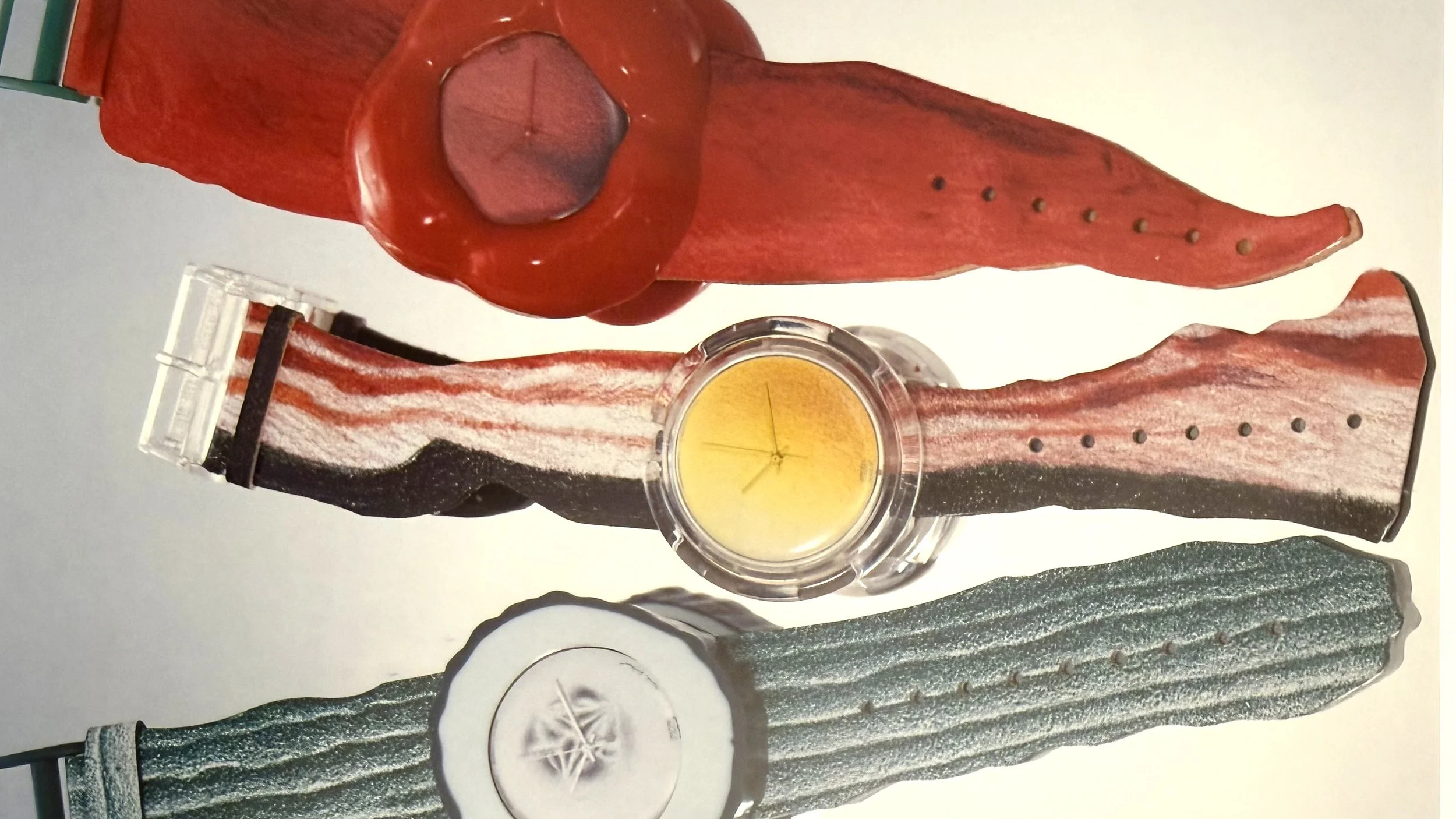
Now that we’ve had tea, would you fancy some eggs and bacon, with a side of fresh-cut, glistening veggies? The wacky non-edible Swatch watches in image 2, designed by Alfred Hofkunst, premiered in 1991 as a limited edition. As a promotion, Swatch sold them in actual vegetable markets. There’s a cucumber, a fried egg over a strip of bacon, and a red pepper model, all rendered in delectably detailed plastic and rubber. A page from the book “Swatchissimo, 1981-1991,” which celebrates the first 10 years of Swatch production, shows these watches in all their puffy glory. My favorite feature is the names of the models, which are multilingual puns: “gurke” means “cucumber,” so “Gu(h)rke” incorporates an h in the word to form a pun on the German “uhr,” meaning clock or watch. The breakfast one is called “Bonju(h)r,” a similar French/German pun, while the pepper watch “Verdu(h)ra,” plays on the Italian and Spanish word for “vegetable.”
As you might imagine, these food Swatches are collectible, with a set on eBay available for $630 at the time of writing. Have you always wanted to embody the crispness of a crudité tray? Or would you feel perturbed by a brunch guest missing their fork and biting your wrist instead? That’s certainly a risk you’ll have to take if you want to wear one of these.
If watches can be food, then watches can appeal to those in the food industry. Celebrity chefs are a known watch-collecting community, with chef-watch couplings reading like wine pairings on a menu: Kristen Kish and her Cellini, Dominique Crenn and her Royal Oak, Gordon Ramsay and his white gold Submariner “Smurf” (or one of his many others). Hodinkee recently ran an article by multi-hyphenate chef and writer Eddie Huang in which Huang nominally discusses wearing a watch in the kitchen, while musing about Pop Smoke, getting T-boned in a car full of loose marijuana, and the excruciating mundanity of the hamburger.
In “A Man & His Watch,” a popular book in our library, a couple of chefs are featured, including Eric Ripert, the chef and co-owner of Le Bernardin in New York. In the book, a collection of first-person testimonials, Ripert compares the craftsmanship of cooking to that of watchmaking, writing: “Take making a sauce: you can’t measure an ounce of flavor–it doesn’t exist that way. It’s intangible; you can’t dissect it…So it’s the same with watches: it’s craftsmanship until you reach a certain level of complexity. Then it’s artistry.” Ripert also admits to “banging up” expensive watches in the kitchen: “I have the watch to use the watch!” He wears a Vacheron Constantin Historiques American 1921.
Image 3
Most modern watches are sturdy enough to withstand the steamy, high-contact world of a restaurant kitchen, but this robustness is a relatively recent development. In image 3, an ad that appeared in American Horologist and Jeweler in 1965 touts the development of Incabloc technology. Incabloc is a patented shock protection system invented in 1934; it uses a special spring mounted over a jewel to shield the delicate balance staff from impact when a watch is dropped. According to this Europa Star article, which covers this handy invention in more detail, more than 80% of all watches utilized Incabloc by the 1960s.
In image 3, an ad for Incabloc demonstrates its shock protection feature by comparing a watch to a fragile egg. On the right is a broken shell; on the left is an intact egg, with a cutout showing an undamaged watch movement, with its Incabloc system visibly in place. It stands out because the red ruby is the only part of the ad in color, except for the lyre-shaped spring that is the company logo at the bottom.
We’ve covered celebrity chefs and their watches, but haute cuisine doesn’t have a monopoly on horology. A decidedly less upscale establishment that features in our collection is the Tick Tock Tea Room, pictured in an undated postcard in image 4. This picture stands out immediately among our horological postcards, which mostly feature public clocks, museums, vintage watch advertisements, or historic factories. This card, in contrast, shows a cozy, if dated, red and pink dining room furnished with crimson diner chairs so pleathery-looking you can almost hear them squeak, and decorated with an entire estate sale’s worth of clocks.
Image 4
The Tick Tock was a Hollywood, CA standby that opened in 1930 and lasted until 1988. It served cheap, filling comfort food to lonely transplants, according to this local history, making a name for itself with 65-cent turkey dinners and orange sticky rolls. Art and Helen Johnson, who moved west from Minnesota, decorated the cafe’s first location with a single cuckoo clock, and the theme kind of exploded from there. I can spot at least nine clocks in the grainy photograph above; available photos online show even more.
I think the clocks make the space feel cozy, though I do wonder if the ticking was intolerable. Maybe the Johnsons didn’t keep all the clocks running. From the nostalgic descriptions I read, it seems like the decor helped Angelenos feel like they had a kind of home, where someone was there day or night to welcome them to a dinner table groaning with mountains of potatoes. Perhaps I’m romanticising, but this is the LA I imagine from movies, the way LA imagines itself.
Image 5
For the New Yorkers out there, there’s nothing more local than a bagel. I like an everything bagel with scallion cream cheese myself, but perhaps you prefer nova, capers, or even a BEC? (If it’s a cinnamon raisin bagel that thrills you, we might not be friends.)
We found the drawing in Image 5 in our administrative archives at HSNY. Titled “How to prepare & consume a New York gourmet’s delight,” it depicts a bagel with lox and schmear, separated into its component layers, schematic-style. They are neatly numbered and captioned from top to bottom, with each striation representing a horological in-joke. The top half of the bagel (1A) represents HSNY, while the lox represents the Bulova and Seiko watch companies. At the bottom of the image, an arrow points from the “assembled melange” into the gaping mouth of a bespectacled eater, presumably the gourmet of the title.
We think this was the creation of an HSNY member in the 1970s. There are layers to this sandwich that I will never understand. Why, for instance, are all the parts of the sandwich representative of HSNY except for the lox? Does the inclusion of the Bermuda onion indicate a reference to a specific member (maybe someone who retired to Bermuda?) And most pressing, what kind of bagel is HSNY???
Although the bagel in image 5 is merely symbolic, HSNY hosted “a series of entertainments, picnics and dances” featuring actual food starting with our beginnings as the Deutscher Uhrmacher Verein (German Watchmakers’ Society). The earliest of these events were humble “smokers,” but they evolved into elaborate banquets and eventually into the black-tie galas we host today at venues like the Plaza Hotel. (A few tickets still available for 2026!) In image 6, a selection of banquet programs gives a sense of the scope of celebration over the years.
Image 6
Image 7
In this 2023 article I wrote about HSNY galas and banquets, you can get a real mouthful of what HSNY members and their guests were eating over the years. If I were eating at an elegant HSNY gala in the 20th century, I’d go for the amontillado sherry, the “grapefruit supreme,” or the “tutti frutti ice cream logue,” but skip the “sweetbreads en casserolettes.” To each their own, however!
An early German-language banquet menu in our archives, from 1912, includes some standards like oysters and Brussels sprouts, but also some curious items like “enamel filet with cuvette sauce,” “horological cream puffs,” “spindle clock cheese,” and under salads, “etched hairsprings with double-proofed acidic chronometer oil.” All of the delicious dishes involve puns on watch and clock parts.
If all of this inspires you to get into the kitchen yourself, why not take inspiration from one of our new library acquisitions, “The Gilded Age Christmas Cookbook.” We acquired the volume for our library because of HSNY’s own 19th-century past, recently featured in HBO’s “The Gilded Age,” seasons two and three. Written by Becky Libourel Diamond, the book includes adaptations of real Gilded Age recipes for the festive season (including Hanukkah and New Year's) interspersed with short essays about celebratory practices of the period. Image 7 shows a recipe for “mock mince pie,” a dessert to round out our meal today.
I just ate my weight in potatoes, so I’m too full to be tempted by all the horological treats I’ve written about here. However, I do hope this will inspire you as we head into the holiday season, when every time of day is an acceptable snacking time, and when each hour marker on the dial, if you look closely, just reads “yum.”